
By Jim Testa
In 2004, the DIY Convention asked Greg Attonito
of the Bouncing Souls to be its keynote speaker,
but rather than have Greg give a speech, I was
asked to interview him onstage. This was, beyond
a doubt, one of the most rewarding interviews
I’ve ever done, and it tells so much about
how the Bouncing Souls epitomize the DIY spirit
of the American indie underground, that I thought
I’d dust it off and publish it here for
the first time. Special thanks to Bruce Haring
at DIYReporter.com for allowing us to use this
(and holding on to the transcript!) For fun, we’re
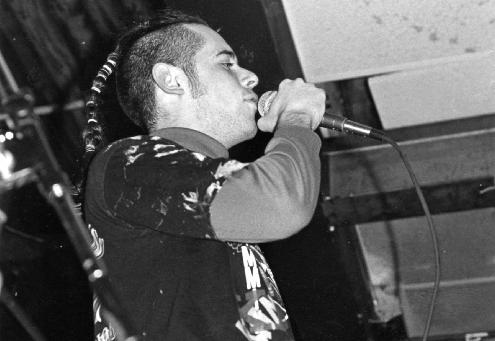
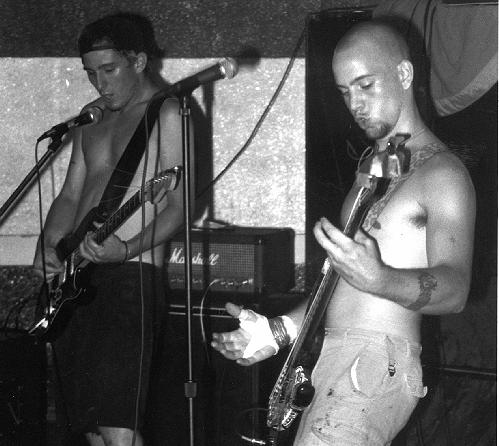
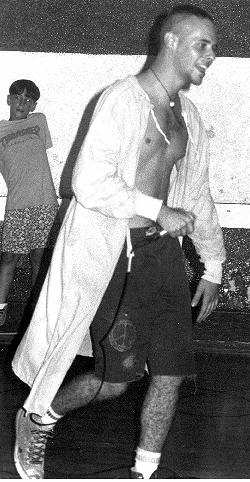
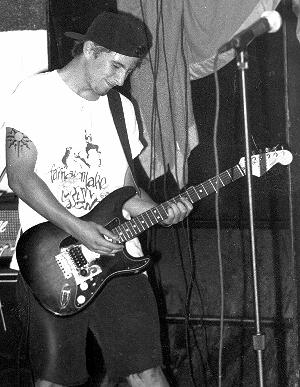
running some early photos of the Souls taken by
Toni Lieggi for Jersey Beat back in 1990 and ’91.
JT: I've known Greg and the Bouncing Souls for a really long time, and Greg knows better than anybody that when I say something nice about this band, I really mean it. When I first saw the Souls, they weren't the best band in New Jersey; in fact they probably weren't the best band on their block. (To Greg) When you
guys started, you were basically in high school, you really weren't a punk band back then. You played a lot of funk, a lot of ska, right?
GA: We were figuring out who we were, as kids do. You hear all kinds of music. Doing everything, copying everything, ripping everything off, we were just a bad band.
JT: That obviously didn't last very long. How many shows have you played in the last year, year and a half?
GA: In the last fourteenth months, we have done roughly about 217 shows.
JT: That's a lot of touring, and the logistics of all that must be insane. When you go out on tour, obviously someone has to deal with all the details involved. You've got merchandise, you've got to get a place to sleep every night, and you've got people that you bring with you on the tour that have to get paid -- all of that doesn't happen overnight. So let's talk about the journey that brought four high school kids in a basement to where you are today. When you first started, obviously it was just the four of you?
GA: Yeah.
JT: So, who did what? Who booked the shows?
GA: Well in the beginning, the very beginning, Brian used to steal tee shirts from the supermarket. We would silkscreen them in the kitchen and sell 'em, and then eventually, you'd work and pool all your money. Everything we did, we pulled together. That is the only way to do anything, because you can't do anything by yourself. You want to get together and have people that are going to agree upon, and be honest about everything that you do, and everybody has to want to do it. Without that agreement between the people, nothing is going to work. So, technically, we would work jobs, and whatever needed to be done, we would throw money in. I was like okay I'm putting in a hundred bucks this week, or fifty bucks, and someone would go buy t-shirts. Then somebody else would get the screens. So, okay, we'll print 'em tomorrow. And everybody would just show up. Everybody would do something, even if it was just hanging up the shirts to dry. We'd all help out, there was always a group effort in everything we did. In the very beginning it was just a total group effort.
JT: What was the first thing that you paid somebody to do? How about booking?
GA: Yeah in '93, we had a tour we booked, it was supposed to be with a band called Lifetime, in the summer of '93. Two weeks before the tour was supposed to begin, we got a call and the kid hadn't booked one show. He was like, "That tour? Oh yeah" He gave us the number of Margie (Alban), who was new at booking, she had never booked a tour in her life, but she had gone to a convention and decided she wanted to book tours. She booked our tour in two weeks. We played coffee shops and kind of zig-zag'd around, we drove for like ten hours some nights. It was great, we didn't care, we were just in a band. We were just really excited to get on tour. Since then Margie's become amazingly successful, she's become a major booking agent (Do It Booking) and she books a lot of great acts. It's been a relationship where she learned as we learned all the way, since the beginning.
JT: A lot of the people who are with you today are like that. Just people that you met in the beginning, that were much like you guys, and then fifteen years later.. this guy runs a record company, your roadie published a book about your tours. You really have brought people along for the ride with you.
GA: Yeah, that's been the fun part. I say, "hey, you want to do this?" "Ok, I'll do it." That's how everything works, that sounds about right.
JT: How do the decisions come about as you continued to grow and get more popular? Like with your shows. you have to deal with more and more responsibility, do you just kind of have meeting and the points come out?
GA: Well I had happened to buy the van as my car that I had saved up money for. So I was the guy who would take care of that, I would go out and buy everything for shows. Our friend, his name is Wig, he's a friend of ours from high school, and he had some rich parents.
JT: So he had lots of money?
GA: Yeah, but if he wanted to use it, he would have to ask his mom. We would tell him, hey you should buy some merchandise, we would just bug him to no end because he wanted to go to college and we were like come on just be our merchandise guy on tour. We all finished high school and he went to college, we
lived together, and we would just be on him everyday but he never quit. What we would do is tell him that we had three shows next weekend, we'd go to his mom's house, we would drive there, his mom would take us to the bank and give us like a thousand dollars. We would buy our t-shirts and print them up, and then sell them on the weekend, and then Monday I would go back to his mom and hand her a thousand bucks, so she loved us. There were no problems. It started smaller, with a couple hundred bucks, but then after a couple of months we would come back for more. Whatever we needed, she'd let us borrow, because we were always good for it. So that was the relationship we developed with Wig. He eventually graduated college, and he was ready to go on tour, we had started touring, and he said he wanted to go on tour with us as tour manager and he would take care of the shirts. So he started doing the merchandising, then he teamed up with a buddy, and after going to college for environmental science or something, he started a t-shirt company and now he has a huge t-shirt company (Dogwig Printing). That's how it happened. We deal with him, to be specific. It's not like any regular merch deal. He's responsible for printing the t-shirts and making sure they are at the show. He actually pays the guy who comes with us on tour and sells the shirts. He takes 35 percent of the profits and then 5 percent goes to Brian, who does a lot of work with the artwork and designs, and the rest comes to the band.
JT: (to audience) I am sure you all know this, but if you are in a band that's touring and you don't have merchandise, stay home. Right, Greg?
GA: Yeah. That's what kept me eating and paid for my apartment for the last ten years, the merchandise.
 JT: Who is Timmy Chunks?
GA: Timmy Chunks was a singer in a band called Token Entry, that's how I first met him. We liked his band before we met him, and then we played with his band, and then we ended up becoming friends. He borrowed money from his brother-in-law, who gave it to us, so he borrowed it twice, to put out our first
CD.
JT: On your own record label which is called Chunksaah. which is sort of named after Timmy.
GA: .. .because-ah he-ah talks-ah like this-ah. He doesn't really, we exaggerate it to tease him, but that's where it came from.
JT: So obviously you had a band, you wanted to put a record out, and you guys are DIY to the bone, so you started your own label.
GA: Well we weren't originally, I have to add that. We didn't know anything. We thought, okay, you put out a record and then you go to a label, they sign you, and then you get lots of money, and everything is great. So this is what we thought, we didn't know anything. So Brian spent hours drawing these beautiful things on the packages, like artwork, and sent them to major labels. Anything he did, he did it all the way. We thought we were going to send them to every major label, get everybody's names, send them packets, the whole thing, which turned out to be a huge disappointment. So we went through that, we learned everything by doing it. We spent all our time doing that and nothing was happening, so we pooled our small amount of money that we had together and decided to do it on our own. We're still releasing records by bands that we like.
JT: The song "K8 Is Gr8" is truly autobiographical - "I used to have a home and a big garage, and I traded it in.." Do you remember a specific point where you got together and said: Okay we're not going to go to college, we are not going to get day jobs, we're going to be band!
GA: Yeah there was a few of those, there were a bunch of moments along the way, beginning when we were in high school. Brian was trying out colleges but we didn't even know if we wanted to do this. So we decided somewhere in our senior year, let's finish school and get a place in New Brunswick, and then all of a sudden we were fully motivated to get everybody out there, get in the band, buy a house, it was cool from that point. Then, you know, you reach different points in your life. okay you did this, there were so many points in the first five years where we were just in this limbo. We didn't have any money and we didn't
know if this was going to work. It was a matter of what was in our heart, and I think choosing a life as a musician is not easy, because you are in this world where nothing is certain at all. I think by choosing that life you are just throwing it all out there, you choose not having money and you accept it. You get to points where you just can't handle that. I got to have some place to live! I got to have some sort of money! Luckily we all have people around us that were willing to make those choices. It's hard if you don't people around you that you can count on, to back you up in those moments.
JT: Speaking of "K8 Is Gr8," tell everyone who is Kate.
GA: Well, Kate (Hiltz) was originally the boss of a futon shop, Brian got a job there, I got a job there after that, and she was our boss at the futon shop and she loved music. Her and her brother stayed at the house for years. So she knew the band and she was very supportive of musicians, so when we would go on tour she would come. So being around there all the time, she got intertwined with what was going on and helping us out, that's the kind of person that she is, and eventually she started being a part of the band. Slowly, all of this stuff that needed to be done, business-wise, when we started to tour, she said she would
take care of it and do it. For a while it was very weird because she wasn't even getting paid and she was doing it because she enjoyed seeing the results. She takes care of all the business, all the numbers. For a while, it was hard because it was creating some tension, because she was doing all this work for nothing. But then finally it got to the point where we could say, okay, Kate, now you get "x" percent.
JT: Anyone who knows the Bouncing Souls knows Kate.
GA: Yes, very much so. She takes care of all the business and all the numbers.
JT: How did you wind up on BYO?
GA: Shawn Stern (co-owner of BYO Records), who had been in the band Youth Brigade, saw the band, saw us in Jersey. So he said I need a record. It was cool, they were an independent label. They were going through a time where they were kind of reorganizing the label, so it worked really well. In Hoboken, on
his answering machine, he'd be getting mad messages from people from, like, Denver, asking if they could get our record, mail was coming in, we spent a ridiculous amount of money sending out CD's, it would cost us three bucks postage just to send a couple of things. You spend all your money just to get your record out there. we spent everything we had on a very low level of getting our record out.
JT: You actually worked at the BYO warehouse for a while. I remember getting promo packages from BYO and there'd be a little message scrawled on the envelope, "Hi Jim, it's the Bouncing Souls!"
GA: We lived at Shawn's for a couple of months and then we would just go out on tour. We didn't really have anyplace to live so we'd just crash wherever we were until the next tour came along. We would throw in our money for bills, groceries, rent. Pete actually had an apartment in Hoboken with some other guys, but it got weird. When we were home we'd all crash there until we got so annoying that his roommates threw us out, and then we'd go crash somewhere else for a while until we could get on another tour.
JT: Even after you had some money coming in, you were still sleeping on people's couches.
GA: Oh yeah. That's the thing, even in the last couple of years when we started getting more success, the expenses also go up. So things change and now you have a whole new set of things like you want to become bigger, we had to self-promote ourselves. We literally spent our money out of our pocket to go to
Europe, there was nobody else that was going to do that. Everything gets more expensive.
JT: You went through a couple of years in the mid '90's the record Bouncing Souls came out, and then you didn't release anything for several years. Then you wound up on Epitaph. How did that happen?
GA: We put the record out on BYO, then toured on it for all those periods, and we got some great tours. We were meeting lots of people, getting sponsors. We met with Brett (Gurewitz, owner of Epitaph Records), which was another big step where we had success. He just said that we were great and we talked to him for a really long time. His attitude was that he worked for us, that the label was there to help the band. Not like the musicians were just the employees of the label. Brett believes that an artist should be in charge of his own career. Maybe because he's a musician and he's been in bands himself. So Brett understood that and I think that is why he is so successful. And that's why we went with Epitaph.
JT: You must have had a lot of major labels knocking at your door, ready to sign you, especially in the mid 90's. Did you guys sit down and say no to all the major labels before you even talked to them, or did you decide after?
GA: Well we talked to a couple and we just weren't comfortable with them. It was just like, you know what? I don't really like this guy. It was pretty simple. When we talked to Brett for two hours where he just telling us what he does at the label, what he does for his bands. It was cool. He just knew what was going on and it all made sense, we respected him. All of a sudden it was all turned around. Instead of us trying to kiss some guy's ass and beg him to sign us to his label, here was a guy who was coming after us. And it made sense that way. I busted my ass out there and I am making music from my heart. If it's for real, there are people that want to do the right things with it, and that is what we all saw in Brett. It registered that we
weren't just a commodity to him.
JT: Let me quote another song, "We lived our life in our own way, we never listened to what they say, the kind of faith that doesn't fade away, we are the true believers." You go to a Bouncing Souls show, and this is what you see: Whether it's 50 kids or five thousand kids, they're all into it, they're all screaming out the words. And they just don't know the words, they believe the words. What's that like, looking out from the stage every night and seeing all that come back to you?
GA: It's pretty amazing. It's just way bigger than I could ever conceive, and it's so cool to be a part of that.
JT: Have you ever thought about what it is about your band that reaches people that way?
GA: Well I know when I first originally saw a band that inspired me, and there was a bunch of them - Wishbone, Red Hot Chili Peppers, Yellowman, Toots & The Maytals. When I went there and saw those bands, it was just uplifting. As a kid, you are really searching for something that music can provide. I really felt something. When I went there, it registered inside me, and I knew there was something about it, something that I couldn't even verbalize at that time, I just knew I wanted to do this, I knew this was in me. There were a lot of moments like that. I didn't know at that time where it would lead me, but it was
really something to think about. In all of us there is this potential we have, everybody has it. If you can dream it, you can do it. I really believe that.
JT: You've written about that in your songs too. In the song "Kids & Heroes," you wrote "Hey, where have I gone? I used to be the one looking for a hero, In some far off place, Blindly ever forward, Never knowing all along, The truth was right here In my own song." That's not punk rock; that's poetry, dude.
GA: Thank you, I just have to give credit to Brian and Pete.
JT: You write about a lot of things in your songs. You write about being lost, you write about being depressed. people say write about what you know, but you really do.
GA: I guess it's just the life that I ended up leading. So many times I thought, I just wanna get a regular job. I don't want to do this anymore. It seems like we want some life where we don't want to face ourselves, and I think for so many of us in this world today, it's easy to let yourself get lost in a
world where you don't have to know yourself. As much as it sucks playing bars forever, it's also the most rewarding and empowering thing that I could be doing. I'm doing all the things I was born to do, that I ever dreamed of doing. Whatever we learned we learned from our parents and society, or whatever, those
things imprison us because we are prone to take certain roads. I think deep inside people act like that because they think they don't have any other choice.
JT: Last night you thanked the audience for teaching you that your life doesn't suck, basically that is what you said.
GA: Yeah, basically it's all in my mind. I don't know how other people perceive life or how they allow certain things in life to affect them. So much of the process of coming through the Bouncing Souls is that it's made me want to be in this band for the rest of my life. It's made such a big difference in figuring it all out. The band has put so much into my life that now I've totally forgotten that I'm miserable. It's still there; I don't know how other people perceive life, I can't get into their heads, but for me, it's just my process of getting out this pattern of learning how to see the world. Music was my avenue out of that. It's what's made me want to keep living.
JT: Another song, "New Day." You wrote, "People tell me they wake up every day, Wondering if they'll be here tomorrow. I say live for today cuz everything you have is just borrowed. No progress made just sittin' around, TV's selling bullshit by the pound, Things stay the same are you afraid to ask why? Fight to
live! Or are you waitin to die?" That's addressing this very topic. That's totally what we're talking about.
GA: Everyone has experienced a moment where you think, Wow, this is amazing! We've all experienced that. And then you think, well, how come I'm not like that all the time? These are the questions that I ask myself and it's because the circumstances of our lives. You worry about money, you worry about all this bullshit. We're so critical of outselves that way. So Brian, Pete, and I all had that kind of spirit, and I think that's why we get together and write that kind of stuff, because with everything we've been through, we've had to turn the tears in the opposite direction and just let go of all the negative stuff that we hold onto. That's how we do it, with our music.
JT: This is my favorite Bouncing Souls song: "I don't want to be this way, kick myself, wish I could say, that I have no regrets today." So. Any regrets?
GA: No. Not a one.
JT: There are about ten minutes left anyone want to ask anything?
(Audience Question) Have you ever thought about playing overseas for the troops?
GA: Yeah I think it would be cool.
JT: You guys met some troops stateside who then went to Iraq, I know that on the Bouncing Souls website, BouncingSouls.com, there is a thing called "Letters from Iraq" where the soldiers write you guys about what's going on over there.
GA: Yeah well we played in Germany and we met a bunch of soldiers, and we spent a weekend where we all went out together. They were all leaving for Iraq in a couple of days. They were very nervous and they didn't know what was going to happen. It ended up being those guys on our website, the ones writing in the "Letters From Iraq" thing on our website. And they're over there driving tanks in their Bouncing Souls t-shirts and shooting off these really big guns with Bouncing Souls written on the side. (So the website) in a way, it's an unofficial Bouncing Souls way to pay tribute to the troops. As far as going over there to play, I don't know if they would accept us, maybe they would, maybe we should look into it more, because I would really like to go there and do that.
JT: Last night was the Rock Against Bush show and I know you guys have been active with PunkVoter.com. Do you have anything you want to say about the election coming up?
GA: Just get out there and vote. In the past I have been apathetic towards thinking that this has nothing to do with me, it's a whole other world. But this year we all just have to get out and vote.
JT: Here here. Question?
(Audience Question) What do you think of the current NJ music scene and especially what's going on with the revival in Asbury Park?
GA: Well I'm kind of the last guy to ask about the actual scene in Jersey because I have been on tour for the last eight months. I really don't know specific things that are going on in Jersey, but in Asbury Park it looks like there is a revival of a lot of things in music. I think by the nature of the way music is supported in America, it's like the last thing that has any real help. You go to Europe and they have these amazing venues, the shows there are great, they have awesome accommodations for bands. You play the show and then they feed you this amazing home cooked meal, and then they come out and ask, "Eez everything okay?" We are just a punk band, you know? When I first went there I said "you got to be kidding me, bro, But then you're like, wait a second, they appreciate music, they are not trying to throw a bag of chips at you and a six pack and say, well, we don't have to do anything else. People just get this attitude here. I am just generalizing very big, there are some amazing promoters in America, there are some amazing people in America, I am generalizing, and I am America-bashing either. I am just setting an example for other places, I am just studying examples of other places and how it's done, and I've always thought that the way it's done in Europe is really cool. I ask myself, why can't this happen in America? Everything is there, the beds are so cheap, you can just go there, and eat and sleep for next to nothing. I'm just rambling here.
JT: I can say that if the Bouncing Souls were eighteen again, they would have a much harder time.
GA: Definitely.
JT: I think in certain ways New Jersey was a much more hospitable place back in the late Eighties and early Nineties. You guys benefited hugely from City Gardens, that was a venue where you could play to a thousand people at one show and reach more fans that you could at 50 basement shows. On the other hand, for the average punk bands that are starting out today, to go out and tour today is much easier. The Internet makes it easier. The network that (the Bouncing Souls) and the generation before you created is there. So bands today can take advantage of that. To get out of town is probably easier; playing in New Jersey, it's probably harder.
GA: This I wouldn't know.
(Audience Question) Any advice on how to keep a band together, especially when the relationships between the members of the band get strained sometimes?
JT: Sometimes different members of the bands have different goals or a different level of commitment. How do you work those kinds of problems out and keep the band together?
GA: You have to be totally honest about what you want to do. Everyone has to be honest. You have to like each other, you have to like being around each other all the time, because you are going to be around each other all the time. It's like getting married and you have to appreciate everyone's ideas and respect
them, even if you might not like them. If they are determined to do something that you don't like, always state your opinion. And be aware that there are all these things that go into a relationship. Most of all, you have to want to do it. You have to love it.
JT: A couple of friends of the Bouncing Souls put together a DVD called Do You Remember? Fifteen Years of Bouncing Souls. It's available from the Chunksaah website, and it's an amazing documentary of the band's history, if you haven't seen it. It's totally honest. I mean they deal with things like when Shah (the first drummer) left the band, things that Greg and Brian has gone through, every piece of dirty laundry is in there, , including all the good memories, people throwing toilets off of roofs. . These guys had some pretty crazy years. I would totally recommend that you pick this up. Not only that but it's a fun movie to watch, and you'll find out everything about the Bouncing Souls that you wanted to know. It shows you brick by brick how they built where they are today. It's a really well done piece of work.
(Audience Question) What's the next step?
GA: I don't know. Right here. Here we are right now. That's the way we have always done it. So what do we do now? Whatever we feel. Musically, whatever. we'll see.