
 Sensual
Harassment—Escape from Alpha Draconis (Coastal Ghost) Sensual
Harassment—Escape from Alpha Draconis (Coastal Ghost)
Reading Sensual Harassment’s Soundcloud profile (“Sensual
Harassment is a Reptilian Humanoid alliance utilizing sonic
mind control . . .” etc. etc.), it’s easy to be
turned off by the absurdity. Judging by the music video for
“Disco Heart,” during which a flight attendant
dressed like Jenna Jameson gives a bunch of 20-somethings
anonymous pills that look disappointingly like Amoxicillin
so they can rave on a spaceship, Escape from Alpha Draconis
seems to be a concept EP glorifying the fun, guiltless, stupid
pleasures of a club culture with which I have an incredibly
anxious relationship. The ideas behind Escape could have just
as easily become a conceptual porn script or a (pretty good)
frat party, which I guess speaks to the odd versatility and
superfluity of the band. As an aside, “I feel a disco
in my heart” may be the poorest lyric ever written,
rivaled only by Hootie & the Blowfish’s “dolphins
make me cry.”
But thankfully, the self-described “epileptic space
disco” Brooklyn trio’s absurdity lies chiefly
in lyrics and concepts, and not in their music. What they
do well is all they claim to do in the first place, minus
the mind control bits: Make good and utilitarian dance music,
and in this respect Escape is a success. Though each song
uses the same, age-old disco groove, it, strangely enough,
works (almost) every time. At their best, the tracks are
a sort of tribute to Cut Copy, and are unabashedly 80s (see
the chorus on “Rescue Me” for proof). In short,
if you’re interested in serious electronic music,
this is not the territory you want to be exploring, but
if you want a light, generally unimportant collection of
dance tracks to snort MDMA to, here is your peak potentiator.
 BEACON
– The Ways We Separate (Ghostly International) BEACON
– The Ways We Separate (Ghostly International)
With all the rote and generally uninteresting R&B and
minimalist revivalism (Autre Ne Veut, The xx, etc.) going
on now, Brooklyn-based duo Beacon live up to their name as
a bright guidepost for groove-based electronic. The Ways We
Separate is a desolate record, fostering a kind of aloneness
only accessible via digital processing. The aloneness acts
as a kind of Higgs field that gives the music itself a uniform
substance: Held, complex chords wash over syncopated drums
and wandering melodies on nearly every track, but the album
doesn’t stagnate. Instead, the individual songs do something
unusual in electronic music—form a cohesive aesthetic
whole.
The album opens up with the reverb-drenched arpeggios and
soft postdub groove of “Bring You Back.” Production-wise,
“Bring You Back” sets up the rest of the record.
It builds layers upon layers of looped rhythms and melodies
that create a chamber the stark, hollow vocals can inhabit.
Weirdly but interestingly, you’ll begin to notice that
the music provides the record’s motion, the vocals its
foundation. Another standout track, “Drive,” immediately
recalls Thom Yorke’s solo work in its dissonant bass
leanings and drum-work that suggests a live performance.
As concerned as The Ways We Separate is with a mood of ruminating
loneliness, the most interesting part of any one of the ten
tracks is its attention to rhythm. It’s deceptively
simple to fall into the halfdozen grooves all subgenres of
electronic music have processed the life out of: 140BPM dubstep,
doubletime drum ’n’ bass, halftime R&B sampled
from the Isley Brothers or something, lounge, you get the
idea. Beacon seem to be as much concerned with syncopation
as they are with production value, and that’s why this
release is going to be a mainstay of recent bass music/postdub/
neo-R&B/whatever. Though the criteria for the epithet
“mainstay” in electronic music seems to have diminished
to “not immediately dismissed as trash,” so who
knows. I like them.
 Atoms
for Peace—AMOK (XL) Atoms
for Peace—AMOK (XL)
Let’s not lie to ourselves here. Atoms for Peace is
not a band in any traditional sense of the word. It’s
a Thom Yorke solo project with minor contributions from Nigel
Godrich (his longtime producer), Joey Waronker (drummer for
Beck, R.E.M.), Mauro Refosco (percussionist for David Byrne),
and Flea (dick-in-sock funk-bass enthusiast/actually talented
man). I’d wager that if you hadn’t been told anyone
above is featured on the record, you’d think of AMOK
as just The Eraser II, which it sort of is, albeit
with better bass-playing. It seems obvious that the only setting
in which the incredibly proficient contributors will truly
be present is a live one, but that doesn’t mean the
record itself doesn’t succeed as a studio venture.
What differentiates Yorke from his electronic contemporaries
is that he’s an immigrant, an alien exploring their
turf. Watch the music video for Radiohead’s “Just”
from ’95: There’s no possible way of guessing
that he’d be playing Reason maestro/crooner with Flea
almost 20 years later. Or maybe there is. But both Yorke and
Flea have also got strong backgrounds in black music: funk,
soul, R&B, and variations thereon. These two factors,
that Yorke originally fronted a rock band and that his musical
palette is expansive and groove-based, make his forays into
electronic genres interesting and, for the most part, superior,
and also renders almost any future collaborations unsurprising.
AMOK is no different in this respect, a product of
the above factors. Take “Judge, Jury, Executioner”
as proof of this: who else is making electronic pop in a subtle,
mindbending 7/4 without sacrificing melodic strength or even
danceability? “Reverse Running,” rhythmically
probably the coolest and most intricate track on the album,
stretches thin the belief that Yorke (by no means a virtuoso
drummer) makes all these patterns himself. Perhaps in this
small but not unimportant way Waronker and Refosco are displayed
as more than timekeepers.
Which leads me to another important distinction AMOK
makes relatively clear: The diminishing size of Thom Yorke’s
ego. Yorke never publicly bought into the stardom that he
got with Radiohead; in fact, he actively/vehemently rejected
it, but in such a way that implied a certain paradoxical kind
of arrogance—that of the cynical and emotionally unpredictable
artist using his fame to decry fame. Lately, however, there
has been a shift towards less world-/politics-oriented and
more personal art. And while it would be hyperbole to say
that his presence on AMOK is minimal, it certainly is moderated;
even the sort of oxymoronic idea of a “collaborative
solo album” speaks to this.
The material on AMOK is characteristically bizarre
and mostly beautifully made, but it’s sure to alienate,
too. Those expecting anything close to a Radiohead album will
be predictably disappointed, and those who want Yorke to buy
in wholesale to the electronic movement will also feel cheated.
But for those of us who want a fascinating and monolith-riddled
collective testing each other’s personal and artistic
waters: AMOK succeeds and gives insight into Yorke’s
seemingly inexhaustible musical capacities.
 Nova
Nova & Peter Hook–Low Ends (Atal Music) Nova
Nova & Peter Hook–Low Ends (Atal Music)
Low Ends, a collection of an eponymous track and
its various remixes, is the product of an unusual relationship:
French House artist Nova Nova and former Joy Division/New
Order bassist Peter Hook. Here is a very long and weird and
kind of unnecessary history of how the partnership came to
be.
While an interesting experiment, Low Ends could have
just as easily been made by an amateur with access to Reason
and Pro Tools and a bass with only D and G strings still functional.
Its defining characteristic—Hooks upper register bass
diddling—could be from an old Destroyer demo or some
kind of neo-lounge attempt by a bored/stoned Berklee student.
Without a (great) band behind him, Hook noodles away sort
of aimlessly, sometimes playing something cool or pleasing,
but mostly just noodling.
The two remixes (named “SLABB” and “THIERRY
CRISCIONE,” presumably after their respective remixers)
just reinforce the aimlessness. “THIERRY” literally
sounds like Hook is just fucking around over a drum loop and
campy synth. “SLABB” is probably the most energetic
of the whole collection, and I think that’s mostly due
to the drums and synth-strings accompanying Hook’s syncopated
playing and to the whole production sounding like it’s
from 1983. Which isn’t a terrible thing necessarily,
but in the context Low Ends as an unsatisfying whole, simple
regard for musicality doesn’t do much to save the track
or its subsequent counterparts/replicas.
 Shlohmo
– Laid Out EP (Friends of Friends/Error Broadcast/Wedidit) Shlohmo
– Laid Out EP (Friends of Friends/Error Broadcast/Wedidit)
Few musicians are as scattered as Shlohmo (Henry Laufer),
style-wise. That his modest discog is consistently inconsistent,
but also consistently interesting, is just as much a result
of his releases frequently being reinterpreted as of his actual
proficiency as an artist. So when an EP of only Shlohmo material
emerges, without reworks, re-edits, or remixes, I get cautiously
stoked.
When “Later”—the first single off this excellently-crafted
EP—emerged on YouTube about a month ago, all traces
of caution vanished. The track is the crown jewel of the record,
if not of Shlohmo’s entire collection. Its production
and its harmonic impulse set a new standard for the electronic
genre: screeches bordering on lo-fi blur the lines between
human and digital and provide a melody so epiphanic that it
seems to make everything else around you ignite and burst.
But as wonderful a benchmark as “Later” sets for
anyone dabbling with an MPC or Kaoss Pad, it also dooms the
other four tracks surrounding it to be overlooked in its shadow.
I can’t imagine that Shlohmo wasn’t aware of this
during the album’s creation; it would explain the track’s
length and its position in the absolute middle. I think it’s
helpful to understand the EP’s structure in terms of
a (successful) drug experience: An anxious two-track comeup,
humanized by How to Dress Well’s searching vocals; an
extrasensory peak; an ambivalent two-track comedown. It’s
no accident the last tracks are shaded darker than the first,
ending on “Without”—signifying a lack, an
empty space the substance used to fill, however temporarily.
What the Laid Out EP really means for Shlohmo is consistency.
It’s a release with a very clear emotional intent; from
start to finish you’re convinced (as Shlohmo now seems
to be) of what his music is telling you. And even though the
EP’s trajectory is bleak, with only six minutes worth
of joy over five fairly sprawling tracks, it graces us with
instances of both the beautiful and the grotesque. This new
Shlohmo, with a fearless attention to emotion, accomplishes
in under thirty minutes what most electronic artists spend
years trying to do or are too enamored by masturbatory Wubstep
to comprehend.
 QLUSTER
- Lauschen (Bureau B) QLUSTER
- Lauschen (Bureau B)
Before you begin reading, know that Qluster were once Cluster,
and, still earlier in their bizarre and nomenclature-obsessed
career, Kluster. So it’s this sort of meticulousness
you’re about to get yourself into on Lauschen.
Now, I have a lot of patience with electronic music. I have
sat through Oneohtrix Point Never’s Rifts collection
dozens of times and have never once felt the pangs of boredom
that threatened my central nervous system I experienced my
first time through Qluster’s latest record. But OK,
for the skeptics who can’t (and/or have no desire to)
tell shit from shinola when listening to this unique brand
of electronic that lacks any discernible beats or melodies:
I understand your position entirely. Sometimes it really all
just seems like a lot of semi-intentionally-placed noise.
But what puts a dude like Oneohtrix (Daniel Lopatin) on a
different plane of beatlessness than Qluster is his sense
of motion, of pulse. If you’re a skeptic and you put
on a record like Replica or Returnal, you
still might get bored, but you’ll at least notice overarching
musical shifts, movements, feelings.
Not so with Lauschen, which—disappointingly—translates
to “Listen.” The record as a whole shouldn’t
even be divided into tracks (the tracks themselves mostly
clocking in at 6+ mins anyway), because there are no real
key signatures or harmonic architectures to differentiate
them. This is the kind of record that makes people who are
too pigeonholed to give electronic music a shot stay that
way. The sounds are tastelessly tossed about; the bass tones
on “Urania” literally become a symphony of nautical
flatulence. But to talk about the track names for a second:
“Klio,” “Thalia,” “Polyhymnia,”
“Terpsichore,” read like planet names (in reality
they’re references to the Greek Muses, but the outer-space
thing still holds up), and yeah, I get that they’re
trying to build “sonic landscapes” but Christ,
what a boring solar system/mythology they’ve wrought.
“Thalia” plays like a Martian Schoenberg’s
first wet dream mopped up and dripped onto a Casio. That’s
not an image I want abstracted into sounds.
I expected quite a bit more from this record. There’s
so much great European electronic music: Modeselektor, James
Blake, Cassius, Apparat, Casa del Mirto—the list goes
on endlessly, and from almost every country in the EU. Lauschen
is negligible at its coolest; at its worst, the sonic equivalent
of 15mg Xanny bars.
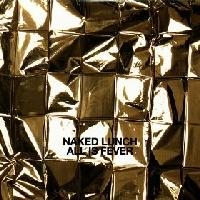 NAKED
LUNCH - All Is Fever (Tapete Records) NAKED
LUNCH - All Is Fever (Tapete Records)
“Keep it hardcore” is the first utterance from
Austrian pop/rock band Naked Lunch’s fourth record,
All Is Fever. It’s a command that’s never
even slightly realized, either because of a Monty Python-esque
German/English translation book hoax, or because the band
was too steeped in riffing on Coldplay to remember why they’re
talking about hardcore in the first place. The rest of the
record follows suit: melodies begging to be sung en masse
by teenagers and banal ‘music-as-spiritual-destination’
lyrics like “I need to get my place in heaven / I need
another show.” Some songs like the first (the deceitful
“Keep It Hardcore”) and the third (“At the
Lovecourts”) border on anthemic, if the vocal’s
lethargy didn’t keep it from achieving any sort of emotional
import. Another interesting harmonic factoid about “At
the Lovecourts” is how eerily similar the verse melody
is to that on Arcade Fire’s “Neighborhood #1”
from 2000’s Funeral.
Generally, what I’m saying is that All Is Fever
plays like a distillation of what makes modern independent
music kind of dull. The Coldplay influence (I hesitate not
to use a more incriminating word) is jawdropping/clenching-ly
obvious, and their affinity for misnomers is just shiver-inducing.
I will provide a short list of these: “Keep It Hardcore”
being about as Hardcore as a virgin birth; “Hammer
It All” being, literally, a waltz; and on a more macro-
scale: “All Is Fever” being hypothermic; and
Naked Lunch, whose music could be equally fitting at an
Applebee’s or a T.J. Maxx, being a reference to one
of the most repulsively cool and “Hardcore”
novels ever written.
This review reads as a definite dismissal of All Is Fever
and of Naked Lunch as a musical institution. While it’s
true that I will never pick up this record again, I’ll
concede that there are minute suggestions of cool: “My
Lonely Boy,” barring its stupid Dickensian lyrics
and chordal foundation of just going up a major scale a
bunch of times, has some interesting sonic qualities to
it, especially the acoustic guitar tone at the beginning.
There are other flashes of talent, but I’ll leave
them unillumined and waiting to infuriate you and Chris
Martin alike.
 THE
EPILOGUES - Cinematics (Red General Catalog) THE
EPILOGUES - Cinematics (Red General Catalog)
Equally-partitioned amounts of 90’s Emo and 80’s
Arena Rock have left their indelible mark on The Epilogues’
latest effort, aptly titled Cinematics. These influences
inherently limit the range of harmonic experimentation the
band allows itself, but they do pretty well within the tight
confines of that structure. This is mostly due to Chris Heckman’s
ear for diverse melodies. While some hooks are stagnant pop-iterations
(“Call Me a Mistake” (aside: OK, I will.)), others
recall the likes of My Bloody Valentine in their length and
meandering beauty (see: “My Misinformed ‘John
Hughes’ Teenage Youth”).
While Heckman’s melodic ideas drive the album, his voice
is another deal entirely. At best it’s gritty and slightly
effeminate—at worst it recalls a nightmarish sonic abortion
hovering somewhere between Jesse Lacey and Geddy Lee. Again,
“My Misinformed . . . “ shows the brighter side
of that spectrum. “Foxholes” is like a minute
long, and is total filler. There also seems to be this recurring
guitar riff/motif; it’s a bit difficult to explain,
but it’s built upon a Eastern-tinged half-step—whole-step—half-step
architecture. I trust you’ll hear what I mean and that
you’ll decide whether or not it deserves to be called
redundant.
My biggest issue with Cinematics is weirdly one of
its strengths. Every song explodes, becomes a self-contained
film of a track. That’s not to say the record would
function as a film score—it is both the film itself
and its own score. Which is kind of a really cool idea, except
when it sags, which it does, repeatedly. I do like this band,
and Cinematics is absolutely worth a listen. But there are
obvious peaks and valleys, and it’s better to take it
on a song-by-song basis.
JerseyBeat.com
is an independently published music fanzine
covering punk, alternative, ska, techno and garage
music, focusing on New Jersey and the Tri-State
area. For the past 25 years, the Jersey Beat music
fanzine has been the authority on the latest upcoming
bands and a resource for all those interested in
rock and roll.
|
|
|





 |
|