
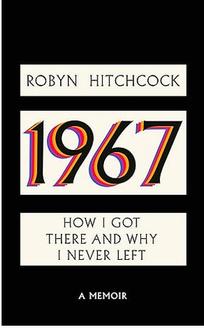
1967 - How I Got There and Why I Never Left by Robyn Hitchcock (Akashic Books)
Part music journalism, part autobiography, and 100% Robyn Hitchcock, 1967 is Hitchock's witty, insightful account of his life in the titular year. The story begins a bit before that titular, revolutionary year in rock and extends well past it, but for the most part, this is the story of how the music of 1967 changed both Robyn Hitchcock and music forever. The son of well-to-do and artistic parents, Hitchcock was packed off to boarding school at the age of 13, just in time to experience the Beatles on the gramophone of his new home's common room. If you're already a fan of Hitchcock's music, you're familiar with his dry wit and elegant wordplay, but even if you've never heard one of his songs, you'll enjoy the way he tells a story and especially the way he describes the wonderment and joy of hearing a mind-blowing bit of music for the first time. Even if these boys were posh and entitled instead of street urchins, Hitchcock's bawdy tales of what went on inside a British boarding school in the Sixties are nothing short of Dickensian. The way he writes about discovering the Beatles or Pink Floyd, of discovering psychedelia as it entered the mainstream in real time, both delight and inform. And when a slightly older lad from a neighboring school by the name of Brian Eno starts hosting psychedelic happenings, well, it's like finding one of the lost Dead Sea Scrolls (at least if you're a connoisseur of rock 'n' roll.) Hitchcock will be releasing an album of cover songs from the era in the fall; in the meantime, you can find his playlist of 1967 favorites on Spotify.
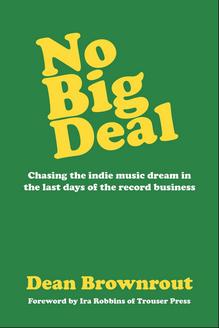
NO BIG DEAL: Chasing the indie music dream in the last days of the record business, by Dean Brownrout (Guernica World Editions)
In this music business memoir, Dean Brownrout tells the story of his days as a music fan, record store geek, promoter, manager, and owner of a small indie label. Brownrout graduated from his beginnings in his native Buffalo, NY to becoming a wheeler-dealer in the corporate world of the music industry in NYC and L.A. in late 20th and early 21st Centuries. Big Deal Records started in the DIY Eighties, prospered during the boom years of the Nineties, and got caught in the dot-com maelstrom of the early 2000's, and Brownrout lays it all out, often with self-deprecating humor but never shying away from ugly details that include broken promises, shifty deals, and corporate BS. Occasionally Brownrout gets lost in the weeds of production and distribution and No Big Deal reads more like a business textbook than a memoir. But when he's talking about bands or records or the music he loved, it's a hard book to put down. Our paths overlapped briefly when Brownrout became involved with the Splatcats, a Buffalo garage-pop band particularly beloved by Jersey Beat, and for that I'll always be grateful. One word of warning: If you're thinking of starting your own label, this little book will talk you out of it big-time.
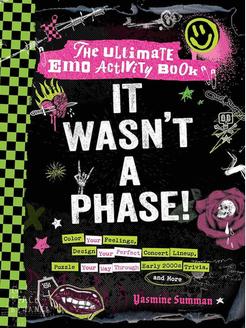
IT WASN'T A PHASE: The Ultimate Emo Activity Book, by Yasmine Summan (Simon & Schuster)
I'm not sure who this was written for or why Simon & Schuster published it, but basically, after a sketchy "history" of emo, author Yasmine Summan has created an "activity book" with coloring pages, quizzes, and fill-in-the-blank questionnaires for those nostalgic for the most vapid, commercial, and trivial aspects of emo culture. So if your idea of fun includes making up your own Mad-Lib lyrics to emo songs or coloring in pictures of fingernails, go for it.

JERSEY METAL - A History of the Garden State's Heavy Metal Scene, Vol. One (1979-1986) by Frank White and Alan Tecchio (jerseymetalbook.com)by Jim Testa
This hefty, densely illustrated coffee-table book more than lives up to its title. In fact, it delivers quite a bit more, since it tells three
distinct stories. As promised, the book chronicles (in encyclopedic detail) the bands, musicians, and venues that comprised the Jersey Metal scene, especially during those boom years from 1973 to 1983 when the state drinking age was 18 (19 after '80) and the club scene literally exploded. The two authors couldn't be more perfectly matched: Frank White started sneaking into Manhattan to see concerts at age 12, armed with his mom's professional camera, and grew up to be a professional concert photographer. His collaborator, Alan Tecchio, played in bands and brings an insider's backstage view of the scene. Secondly, much of the narrative serves as a roman a clef for the two authors, telling their first-person stories and sharing their memories and experiences. Finally the book exhaustively recounts when the major touring acts of the day came to Jersey from across the country and around the world. There are quotes from musicians peppered throughout, but no real interviews; the book prioritizes details over depth. And sadly, it's next to impossible to hear any of these bands today (especially the hundreds of cover acts) and the authors offer little that gives us a sense of what these bands sounded like. The book weighs a couple of pounds and actually gave me cramps while I was reading; it is literally more than a handful. But the wealth of photographs - both by White as well as fan and press photos - kept me glued to the narrative, and the unflagging enthusiasm and passion of the two authors more than compensate for the run-on sentences, repetitiveness, and typos (was it D Show Place or The Show Place?) If you grew up reading The Aquarian Weekly, you will feel very much at home here, and if you're under 40, you'll marvel at what kids were allowed to get away with when the authors and I were growing up. A Vol.Two covering the late Eighties through 2004 is in the works.
The Gospel of THE HOLD STEADY: How A Resurrection Really Feels by Michael Hann & The Hold Steady (Akashic Books)
I'm not sure where the resurrection of the title comes into play. Does it refer to the careers of Craig Finn and Tad Kubler after Lifter Puller exploded, and these unlikely thirtysomethings found success so much later in life than the rock 'n' roll gods usually allow? Or was the "resurrection" the Hold Steady's return from the personal and artistic low point it reached after Kubler hit rock bottom with his addiction problems and the band fired keyboardist Franz Nikolay? In any event, it's clear the Hold Steady remain very much alive in 2023, with a notoriously communal and rocksolid (if not quite arena-worthy) fanbase known as the Unified Scene. Primarily, the book consists of an oral history of the band by its members, which doesn't flinch from some unflattering truths or softpedal the band's heavy (ab)use of alcohol. Interspersed are essays by critics and band insiders that provide insight into the Hold Steady story, and then the Unified Scene takes over and the final third of the tome is devoted to tributes, reminiscences, and love letters from fans. There's also a wealth of photos, although none of them are captioned, one of the many signs that this is a book for and by the Unified Scene, not an attempt to reach or convert a new audience. But if your life motto is "Stay positive," you'll want - nay, need - a copy.
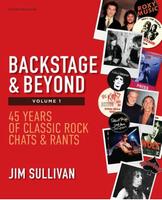
BACKSTAGE & BEYOND, Volume 1: 45 Years Of Classic Rock Chats & Rants by Jim Sullivan (Trouser Press Books)
Jim Sullivan spent 26 years at the Boston Globe, many of them as the paper's rock critic. He's also freelanced for mainstream magazines, underground and alternative publications like Trouser Press and Sweet Potato, The Christian Science Monitor and Playgirl. The man's literally been to hell and back covering rock 'n' roll, and in this first volume, he's used a lifetime of interviews and reviews to cobble together over 30 essays about the gods and demi-gods of classic rock. (A second volume focusing on punk and alternative artists will follow.) Using his own back pages as a database for stories and quotes, Sullivan shares his experience chatting with and watching the likes of Jerry Lee Lewis, Iggy Pop, Ray Davies, Leonard Cohen, John Fogerty, and many others. Women are will represented too: Nico, Marianne Faithfull, Tina Turner, Darlene Love, Joan Baez...As befits a lifetime newspaperman, Sullivan's prose skews conversational and casual; this isn't like reading Meltzer or Christgau and wondering what the hell they meant. I knew Jim Sullivan by reputation more than by reading him, since the Globe didn't make it to New Jersey on a regular basis. But my friends in the Boston scene - and I practically lived with one foot in Boston for parts of the Eighties - talked (or rather complained) about him often. In fact, when Sullivan and I first met - at a SXSW softball game - I introduced myself by saying, "None of my Boston friends like you." Fortunately, Jim forgave me for that gaffe and we became friends, and now in reading these essays, I see his honesty in action. Sullivan talks warmly about his friendship with Jerry Lee Lewis, for example, but doesn't shy away from detailing the Killer's many misadventures with the law or his weakness for much younger women. He gives us seven pages about his encounters with Ray Davies - fascinating enough - but then follows with 10 about Dave, which prove even more illuminating. John Fogerty's chapter includes his feelings about Tina Turner's iconic version of "Proud Mary;" that's followed by a chapter on, yes, Tina Turner. There are a few chapters that feel unsatisfying, as if Sullivan stitched together what he had to work with but it wasn't quite enough; but then the Warren Zevon chapter had me in tears. My copy of "Backstage & Beyond" is already wellworn and dog-eared. You don' need to read it cover to cover; it's fun to come back to and see what other nuggets you can discover in its pages. Needless to say, I am anxiously awaiting Volume 2, when Sullivan gets to dish on all those Boston indie bands that I hung with, the ones who didn't like him. I can't wait to find out why.
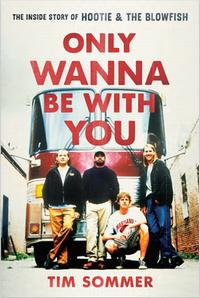 ONLY WANNA BE WITH YOU - The Inside Story of Hootie & The Blowfish by Tim Sommer (University of So. Carolina Press)
When a promo CD of cracked rear view arrived in my mail back in 1994, I listened to it once, decreed it a "third rate Springstreen rip off," and promptly tossed it into my "sell" pile. Hootie & The Blowfish's debut album for Atlantic Records wound up selling over 20 million copies, remained on Billboard's Hot 100 chart for nearly two and a half years, generated four Top 10 singles, and won two Grammies. Shows you why I was a fanzine nerd and Tim Sommer, who signed Hootie & The Blowfish to Atlantic, was the A&R man. I have been friends with Tim since the very early Eighties (he first came to my attention with his gonzo "Noise: The Show" hardcore punk radio show on WNYU, which actually got a mention in Jersey Beat #1,) but I can quite objectively state that this book not only lovingly details the story of one of the most remarkable bands in American music, but also provides a refreshingly candid insider's look at the music industry of the Nineties (and how perilously close this landmark, generation-defining album came to never being released.) After several 2022 listens, I still don't like cracked rear view much (although I wouldn't have made the Springsteen comparison today,) but I thoroughly enjoyed Tim's telling of its story, which doesn't shy away from the thorny issues of race, class, and prejudice that followed his South Carolina frat band with a black singer that made music history. Tim also fairly and unabashedly discusses "Hootiegate," when Jim DeRogatis lost his job at Rolling Stone after penning a lukewarm review of Hootie's second album, Fairweather Johnson (and subsequently dissed Jann Wenner when asked if his boss was a big Hootie fan. "No," DeRo told a reporter from New York Press, "that son of a bitch is just a big fan of any album that sells 10 million copies.") Maybe the album that changed your life was Nevermind or, also in 1994, Dookie; but for an awful lot of kids who came of age in that era, it was cracked rear view. They'll need to read this book, but you should too.

Sellout: The Major-Label Feeding Frenzy That Swept Punk, Emo, and Hardcore (1994-2007) by Dan Ozzi (Mariner Books)
Review by Oliver Lyons
“God dammit that really sucks! / Heard they signed for a million bucks! / These bands have really gone too far when the kids at school know who they are!” - Black Train Jack, “700 Club”
It’s been said that the gun Kurt Cobain used to kill himself left more than a hole in his head; it left a hole in the music industry as well. Nirvana’s Nevermind, buoyed by the momentum of 80’s college rock, was the album that finally broke down the door that separated the underground from the mainstream; and, to everyone’s surprise, the mainstream liked what it heard! Thus began a feeding frenzy where seemingly every artist with dyed hair, a distorted guitar, and a crippling drug dependency was given a six-figure record contract. The first four years of the 1990’s were filled with heroin riddled anthems of teen angst, but by the time Mr. Cobain took himself out, the revolution that was “grunge” had already played itself out to the point of parody (sorry, Candlebox.)
Thankfully, Green Day, with their Buzzcocks by-way-of The Beatles pop-punk songs were just the ray of sunshine the post-Nirvana world needed. Green Day’s major label debut, Dookie, was a monster hit that made overnight rockstars out of the Oakland trio. It also cost them friends, family, and any credibility they had with their “scene” centered around the club, 924 Gilman Street.
Dan Ozzi’s Sellout… begins with Green Day’s meteoric rise to superstardom and then offers snapshots of ten other bands all of whom benefitted from Green Day’s improbable success. If a no-name band from the Bay Area could score a hit song about masturbation, maybe the dissonant skronk of El Paso’s At The Drive In could also burn up the charts?! (spoiler: it couldn’t.) Thanks to a booming 90’s economy and propelled often times by more money than sense, labels started throwing vast sums at any group of kids with nose rings in hopes that they would be the next Green Day. Some of the bands chronicled in Sellout… were able to use those funds to finally realize their musical visions (Jawbreaker, Jimmy Eat World, The Distillers) while others collapsed under the weight of million dollar expectations (the aforementioned At The Drive In.) In the end, only a select few of the bands written about in Sellout… were able to achieve success on the level of Green Day’s, but that doesn’t make the other stories any less compelling.
Though Ozzi often finds nice things to say about each band, his writing style tends to stay neutral. He doesn’t play favorites, nor does he cast any personal judgements, preferring to let the drama of each bands’ story speak for itself. The result is akin to reading 11 condensed 33 1/3 books – you get a little background on each band for context but a majority of the story centers around their major label debut and the aftermath (both personally and commercially.) The order in which the bands’ stories are presented at first seem random (aside from Green Day who had to be first), but the more you read, the more connective tissue you see shared between even the most disparate bands (Gary Gersh, the Geffen head who signed Nirvana, also signed Jawbreaker; his protégée would go on to sign Jimmy Eat World, whose major label debut, Static Prevails, while commercially unsuccessful, would become the favorite album of Blink-182 to the point of them poaching the same producer for their very successful major label debut, etc.) which creates something of an overarching narrative as, thanks to the insular nature of the punk scene, the smallest drop can still cause a large ripple.
Ozzi also offers no judgement or opinions on what exactly “selling out” is or if any of the bands in Sellout… actually “sold out.” He lets each band chime in with their thoughts but leaves the final word up to the reader. He also doesn’t condemn any of the underground punk police like Maximumrockandroll who many of the bands written about in Sellout… actually saw as a necessary evil for the longevity of the punk scene. If having a bar code on their CD meant the occasional nasty ‘zine comment, Slurpee thrown their way, or tires slashed – so be it. The cost of ambition was made well known in the punk scene. What’s funny in Sellout… is how few of the bands chronicled actually had deep ties to their respective scenes! I know Ozzi had to be choosy when picking which bands to write about; aside from the obvious touchstones, they had to be well-known enough to be recognized but not so famous to the point where everything has already been written about them (that means we don’t get the stories of, say, Less Than Jake, Sensefield, or Schleprock - alas.) But I was surprised to discover how quickly a lot of these bands went from forming to being courted by the majors. In the case of Jimmy Eat World, they were scooped up by Capitol after only a few local shows in AZ and essentially put on the payroll while they discovered their sound in the studio. Their serious touring years didn’t begin until AFTER their first major label release?! Even Jawbreaker was nomadic and weird enough that their major label debut caught only 1/9th of the grief from the same crowd who had crucified Green Day. What’s also surprising is how few of these bands hid their desire to sell as many records as possible by any means necessary. Really, it’s only Against Me! who had to stare down the barrel of a thousand disappointed kids demanding atonement for no longer wanting to sleep on floors.
But Ozzi doesn’t condemn those kids either. I assume it’s because he, like myself, was one of them: A teenage asshole who would make snide comments about a band having the audacity to try and make a living from their art all while safely ensconced in their parents’ home with no bills to pay or worries about where their next meal would come from. And who could blame us, really? We were at the mercy of what the radio or MTV gave us. By the 10,000th time I heard “Basket Case”, Green Day had gone from being my favorite band in February of 1994 to whack music my kid sister was into by that fall. The limited selections and lack of social media back then meant we had time to nitpick, fuss over, and criticize every move a band we loved made. Kids would dead-ass use the term “betrayal” when it was even hinted at that a band might jump to a major. So a lot of bands – usually not very good bands - would try and score easy cred by condemning their friends’ bands or make impassioned speeches about being “true p0nx” who wouldn’t “sell out.”
Well, since we’re both here in the future, I think we can safely say: it didn’t matter. With all due respect to Black Train Jack (RIP Rob Vitale), the punk scene survived some of its best bands going major. There’s still kids today putting on shows in basements and releasing records (and tapes for some insane reason.) And even though Napster tanked the music industry in the early 2000’s, taking down its bloated budgets and A&R men with it, punk bands continue to sign to major labels (though with so few labels left, punk stalwart Epitaph, ironically finds itself a major industry player, still pulling in roughly $6-10 million a year thanks to acts like Architects, Falling in Reverse, and Lil Lotus, who sound about as far from Pennywise as you can imagine but who I bet were arguably influenced by at least one of the bands written about in Sellout…). What’s gone is the time and money bands had to hone their sound without worrying about rent. What’s gone is the major marketing arms that could get an album into even the smallest shop across the globe. Bands today can record a slickly produced album on their phone but good luck trying to get noticed in the flooded, online marketplace. Sellout… isn’t a lament of potential destroyed by big business (though it does contain its share of stories about bonehead marketing schemes), but rather a celebration of the bands who believed in what they were doing and took their shot to get their music in front of as many listeners as possible at a time when record labels were practically printing money. And the gamble paid off for about 99% of them. What do idiot teenagers know anyway?

THE WORLD OF BOB DYLAN – Edited by Sean Latham (Cambridge University Press)There have been academic studies of Bob Dylan before, but The World Of Bob Dylan represents the first since Dylan's Nobel Prize for Literature (a touchstone for many of the essays here;) it's also the first published project from the Institute of Bob Dylan Studies at the University of Tulsa. (I wonder if there are college departments devoted to other pop stars? Can you major in The Beatles at Harvard? Or study Smokie Robinson at Rutgers?) That in essence makes this a textbook, and textbooks tend to be, well, boring. You can credit either the authors, editor Sean Latham's wise choices, or the endless fascination we have with the subject himself, but any moderately interested Dylan fan should enjoy most of this The essays are divided into categories (Creative Life, Musical Context, Cultural Context, Political Context,) starting with a (disappointing) chronology that includes albums, tours, and TV appearances, but omits major life moments like his religious conversions, marriages, and children. (I did discover, in another essay, that Dylan had a short-lived marriage and child during his Christian period that I knew nothing of.) There's a meta-essay that dissects the various Dylan biographies, as well as analyses of Dylan as folk, rock and protest music (as well as a consideration of Dylan as a singles artist;) his relationship to theater, literature, the Beats, visual arts, Judaism, and Christianity; a post-modern look at Bob Dylan as a brand; and a thorough examination of his Nobel prize and acceptance speech. Two rock writers wander into the party: Greil Marcus, a giant among Dylanologist, contributes the text of a speech about Dylan and the blues, a potentially rich topic that simply doesn't work without the cadences and emphases of the spoken word, or the songs he played for the audience at the event. Music journalist Ann Powers provides one of the standout essays in the collection though, a look at Bob Dylan's body (as opposed to his face or voice.) Since the essays are all fairly short, the book reads quickly, and you can skip some and choose others that seem the most promising. As summer reading goes, it gets an A for Dylan buffs, and will almost surely send you back to some of those half-forgotten albums for a new listen.
MUSIC IN A WORD: Fifty Years On A Rock 'N' Roll Soapbox (Vol. 1 – Learning To Write, 1972-1997) by Ira Robbins (Trouser Press Books)
Ira Robbins, the editor of Trouser Press magazine, the Trouser Press Record Guides, and these days, trouserpress.com, combines a collection of his music writing with an autobiography in this unorthodox self-published e-book. The story starts with Ira falling in love with rock music as a teen, his first forays into rock writing in high school and college, and the story of how his mimeographed fanzine morphed into a national magazine that chronicled both underappreciated catalog acts as well as the early heroes of punk and new wave . Trouser Press folded in 1984, but Robbins would go on to write for Rolling Stone and other major magazines, newspapers, and eventually the web; in Music In A Word, he recounts his life story interspersed with reviews, interviews, and think pieces. His candor offers a refreshing reevaluation of the Seventies, Eighties, and Nineties, and while Robbins can be tough on himself when he got one wrong, most of his opinions hold up well over time. (It is amusing to read young Ira write about artists in their twenties as “encroaching on middle age” though.) To be honest, I skipped over quite a few reviews of bands I didn't care about then or now; but since there are over 900 pages here, that may in fact be the only way to get through the whole thing, once you download it to your computer, tablet, or phone. (A paperback version may follow, but the book remains digital-only for now.)
Caveat Emptor: Ira is an old friend and our lives did run on parallel tracks, so I may not be the most objective observer. But I did enjoy the book a great deal and recommend it to anyone with an interest in the rock music of the latter half of the 20th Century. You can hear my Jersey Beat Podcast interview with Ira Robbins here.
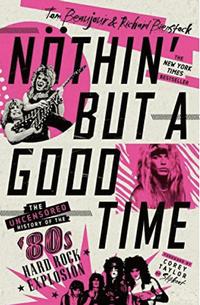 NOTHIN' BUT A GOOD TIME: The Uncensored History Of The '80's Hard Rock Explosion, by Tom Beaujour & Richard Bienstock
There are a few problems with this 500+ page oral history of the hair metal bands of the Eighties. First, it's an oral history. Secondly, it's 500something pages long. And third, it's about hair metal.
Oral histories, for those unfamiliar with the genre, cut-and-paste snippets from hundreds of interviews together to form something resembling a narrative. Tom Beaujour and Richard Bienstock certainly did their homework in interviewing musicians, journalists, producers, roadies, and fans, but that's part of the problem. There are an awful lot of players, and unless you've got an encyclopedic grasp of Eighties rock, it becomes next to impossible to figure out who's who unless you keep one finger on the Cast Of Characters at the beginning of the book. There's some interesting history about the musicians who labored in disrespected cover bands for a decade before their kind of music suddenly came into vogue, and a sobering look back at how quickly this era of rock 'n' roll ended when Nirvana changed the look and sound of mainstream rock virtually overnight. And in the middle, of course, there were a few years when hedonism, hairspray, spandex, MTV, and androgyny fueled the titular "explosion." I've never been a fan of oral histories - they're not really written so much as assembled - and here, there just seem to be way too many dudes celebrating their wild youth and not nearly enough critical analysis of the rampant sexism, misogyny, and drug abuse of the scene. I wouldn't call Motley Crue or L.A. Guns racist, but this era of rock did emphasis whiteness to the point of fetish, stripping rock of its black antecedents in blues and R&B, and that's barely discussed either. As another reviewer noted, for fans who followed REM and U2 and the Clash (or country, or soul, or dance music,) Nothin' But A Good Time feels like the yearbook to a high school you didn't attend.
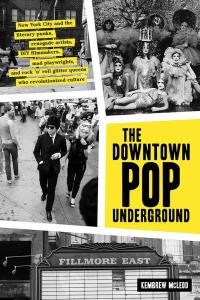 THE
DOWNTOWN POP UNDERGROUND, by Kembrew McLeod (Abrams Books) THE
DOWNTOWN POP UNDERGROUND, by Kembrew McLeod (Abrams Books)
I've read plenty of books about the early days of New York
City's punk rock city, from oral histories to autobiographies
to researched histories, but Kembew McLeod's The Downtown
Pop Underground breaks new ground by connecting the dots between
the Off-Off-Broadway underground of the Sixties and the sexual,
musical, and artistic revolutions that came of age in the
Seventies. This was a world of weirdos, freaks, cross-dressers,
artists, glitter queens, authors, guerilla filmmakers, playwrights,
actors, and musicians - many of them gay, transgendered, or
simply indefinable - who created fabulous (and largely forgotten)
art in the detritus of the Lower East Side's abandoned buildings
and dirt-cheap tenements. Here, icons like Andy Warhol, Lily
Tomlin, Sam Shepard, David Bowie, and Bette Midler cross paths
with a small, intermingled scene of sexual transgressives
and groundbreaking innovators; where pocket-sized storefronts
were transformed into DIY theaters, and squatters, outcasts,
and the disenfranchised blossomed into the superstars of an
underground sub-culture that would subvert and change mainstream
society. McLeod brings these people and these times to life
with empathy and understanding, while never shying away from
the ugliness and ravages caused by drugs and mental illness.
Highly recommended.
-----------------------------------------------------------------------------------
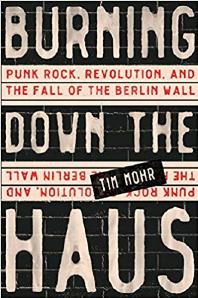 BURNING
DOWN THE HAUS: Punk Rock, Revolution, And The Fall Of The
Berlin Wall by Tim Mohr (Algonquin Books) BURNING
DOWN THE HAUS: Punk Rock, Revolution, And The Fall Of The
Berlin Wall by Tim Mohr (Algonquin Books)
Back in the late Eighties, I used to mail Jersey Beat to
some punks in Poland who were involved in the Solidarity
movement. After the Berlin Wall came down, they mailed me
a piece of concrete from the wall - one of my proudest
possessions - with a note saying that American punk and
fanzines like mine had played a big role in inspiring freedom
behind the Iron Curtain. But that was Poland, which was
always a little more permissive than some other Iron Curtain
countries. In his exhaustive and brilliantly researched
book, author Tim Mohr tells the story of how punk rock inspired
the youths of East Germany. Mohr tells this story almost
like a novel, presenting a cast of fabulously real characters
who managed to hear punk on West German radio, and despite
huge obstacles, managed to start bands and put on shows
in a country where every aspect of the culture was monitored
and controlled by both local police and the national secret
police, known as the Stasi. These were kids, most of them
in their mid-teens; East German youth finished high school
at 16 and were then apprenticed to different jobs by the
government, except for the small handful allowed to go on
to university. Mohr not only conducted hundreds f interviews
to unearth this story but also managed to unlock government
documents that had been kept secret for decades. The East
German punks faced beatings, incarceration, or deportation,
and yet somehow, punk rock took hold in East Berlin, and
the cruel, fascistic crackdowns by the government against
it helped foment the fervor that led to th Berlin Wall coming
down. It's a fascinating story, and while Mohr actually
managed to find photos of some of these bands, I only wish
recordings of their music had survived.
Tim Mohr, author of Burning Down The Haus, will be interviewed
by Legs McNeil at Hoboken's Little City Books (100 Bloomfield
St.) on Wednesday, Oct. 3, at 7 p.m. The band Future Punx
will also perform. Admission is $15 from Little
City Books.
-----------------------------------------------------------------------------------
Jon D'Amore and I went to Weehawken High School together,
and we both grew up in Italian-American families. But there
was one big difference: His family was "connected."
Jon drew on those memories and some amazing true-life adventures
in his first novel, The Boss Always Sits In The Back
(read my review here.).
His second book, Deadfellas, actually started as
a screenplay, for what seems like a no-brainer to me: A
mash-up of two incredibly popular genres, the classic mobster
movie and zombies. When the movie proved a no-go, Jon transformed
his screenplay into this novel, a funny, insightful, and
then ultimately scary story that follows a Mafia family
through several generations, and the gruesome end that ultimately
awaits them. The story takes place in a fictional Nevada
town (like a smaller version of Reno) where a Mob family
has quietly owned a small casino. The Boss decides to expand
the casino, add a hotel, and while he's at it, build a remote
rural mansion where his associates can conveniently and
discretely whack and bury his enemies. Well, it turns out
that the house is on sacred Indian burial ground, and there's
this ancient curse, and yada yada yada... You see it all
coming, but nonetheless D'Amore's account of spiffily overdressed
Mafiosos clawing their way out of their secret graves to
wreak vengeance reads like prime Stephen King (by way of
Mario Puzo.) Goodfellas meets Night Of The
Living Dead, Tony Soprano goes to the Pet Semetary,
The Godfather vs The Walking Dead. If
you love mob stories, the details in the first half of the
book will engross you, and if you're into horror, the finale
will scare the shit out of you. Win/win. And man, I really
hope somebody eventually makes the movie.
 THE
SHOW THAT NEVER ENDS: The Rise & Fall Of Prog Rock by
David Weigel (W.W. Norton & Co.) THE
SHOW THAT NEVER ENDS: The Rise & Fall Of Prog Rock by
David Weigel (W.W. Norton & Co.)
I never liked Prog Rock. I had two roommates in my sophomore
year of college who played Close To The Edge incessantly
when I wanted to hear the Stooges and NY Dolls, and it drove
me crazy. So it came as a bit of a surprise that I thoroughly
enjoyed David Weigel's beautifully written and well-documented
history of the Prog movement. Weigel - a political writer
by trade - uses his journalist's tools to uncover fascinating
personal anecdotes and behind-the-scene stories that make
the characters in the book really come alive. He traces
the ways in which the psychedelic revolution of the Sixties
morped into the Prog of the Seventies, and explains (in
language any layman will follow) the enormous role that
the evolution of synthesizers played in the sound and style
of the music. I never realized how many of the major players
from this genre jumped from band to band, regrouping in
different combinations to put different spins on their grandiose,
polychorded, classically-inspired rock symphonies in 9/4
time. Listen, I'll still take ELO over ELP any day, still
shout "No!" to Yes, and would still rather have
a root canal than sit through Thick As A Brick.
But if you're looking for a good music book to read this
summer, I heartily recommend The Show That Never Ends.
 STAY
UNTIL WE BREAK by Mercy Brown (http://www.penguinrandomhouse.com
/books/318549/stay-until-we-break-by-mercy-brown/978069840431) STAY
UNTIL WE BREAK by Mercy Brown (http://www.penguinrandomhouse.com
/books/318549/stay-until-we-break-by-mercy-brown/978069840431)
Mercy Brown, the pseudonymous survivor of New Brunswick's
Nineties alt-rock scene, returns with her second romance
novel, continuing the adventures of a plucky indie band
with a great sound and big dreams called Stars On The Floor
(or Soft.) In her first novel, Loud Is How I Love You,
Brown introduced us to Travis and Emmy Lou, the guitarists
in Soft who follow a predictably rocky path to love. They're
back but only minor characters in Stay Until We Break,
which follows the band on an East Coast tour and focuses
on the group's hunky but damaged bassist Cole, and its game
but untested road manager Sonia. If you're old enough to
remember the days of the Melody Bar and Roxy, you might
recognize some of these people (Emmy and Travis are based
on the author and her real life husband, but the characters
in the second novel tend to be composites.) Still, the story
is peppered with anecdotes drawn from real life, and the
writing about the exhilaration of being young, in a band,
and on the road for the first time rings totally true. Be
forewarned: This is a romance novel, which means it hews
to a certain formula (lots of sex) and predictable plotlines.
But it's a fun breezy read that brought back a lot of fond
memories for me (hey, I even review Stars On The Floor's
first single in the book!) For younger readers, it's a wonderful
primer on the halcyon days of indie rock and a great enducement
to get in a van and do it yourself while you still can.
 LET’S
GO TO HELL: Scattered Memories Of The Butthole Surfers by
James Burns (Cheap Drugs) LET’S
GO TO HELL: Scattered Memories Of The Butthole Surfers by
James Burns (Cheap Drugs)
Despite the sub-title “Scattered Memories,”
super-fan James Burns has compiled a lovingly and fanatically
detailed biography here of one of the weirdest and most
underappreciated bands of the alternative era. The ‘Surfers
released records with no song titles, no credits, no lineup
information, so whatever’s known about the group’s
recordings has been compiled by an underground network of
tape traders and record collectors, which is how Burns’
interest in the band started. This bio, often hyperbolic
and oozing with flowery phrasing, nonetheless does an amazing
job of piecing together the band’s fractured history,
near-constant personnel changes, and nomadic tours. Hardcore
fans will love the hundreds of pages of annotated discography
compiled at the end of the book as well.
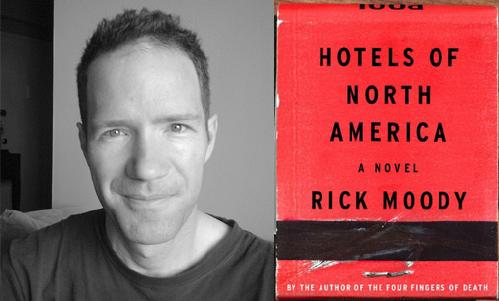
HOTELS OF NORTH AMERICA by Rick Moody (Little,Brown)
Rick Moody's new novel purports to be the collected writings
of one Reginald Morse, a "top-rated" reviewer
on the hotel-rating site RateYourLodging.com. As soon becomes
obvious, though, Morse has little to say about hotels, and
a lot to share about life, family, and most of all, loneliness.
Over the course of his collected reviews of mostly cut-rate
hotels, we learn of Reginald's marriage, divorce, and second
chance at romance with a woman known only as K. We learn
he has a daughter, whom he rarely sees, and we infer that
his career has hit the skids, from a promising start as
a stock broker to a fly-by-night motivational speaker whose
need for paying gigs takes him across the country and sometimes
the world. He frequently seems to stay in the sort of dives
that have bulletproof plexiglass in the lobby and cockroaches
and bedbugs in the rooms.
Reginald Morse is never dishonest, though, neither about
his accommodations nor his own peccadilloes. He writes as
sanguinely about filthy carpets and complimentary toiletries
as he does about his addction to hotel porn and a foray
into phone sex with a male prostitute in Manila.
The life story we infer from Reginald Morse's reviews tells
a great deal about the plight of the American middle class,
about middle-aged men who fell into the Bush recession and
never quite managed to climb out again. But his dispatches
also offer commentary on the nascent art of Internet writing,
of the run-on sentences and self-important pretensions of
people who find relevance only on message boards and comment
sections. Of course, as Reginald's online popularity grows,
so does his exposure to trolls, and he sometimes has to
fight back against other anonymous online entities who challenge
not only his credibility, but his very existence.
Does Reginald Morse exist? In his Afterword, Rick Moody
tries to answer that question and admits he doesn't know
the answer. The Reginald Morse who described his stays at
the Willows Motel in Boston Corners, NY and The Mason Inn
Conference Center & Hotel in Fairfax, Virginia vanished
from the grid after his last posting in 2014. At that time,
Moody tells us (with a nudge and wink,) RateYourLodging.com
was absorbed into a media conglomerate and all of its freelance
reviewers let go. Reginald Morse's online existence was
erased with the stroke of a keyboard; this book, his collected
postings, becomes his only legacy. As we live more and more
of our lives online, do we invite the same fate?
Hotels Of North America is frequently laugh-out-loud
funny, sometimes oppressively sad, but always compelling.
It only takes a few pages for Reginald Morse to spring fully
to life, his run on sentences and shameless self-obsessed
blovation addictively hooking the reader with page-turning
urgency.
 HOW
TO RU(I)N A RECORD LABEL: The Story Of Lookout Records,
by Larry Livermore (Don Giovanni) HOW
TO RU(I)N A RECORD LABEL: The Story Of Lookout Records,
by Larry Livermore (Don Giovanni)
Larry Livermore’s first memoir told the story of how
he lived off the grid for many years in a remote mountain
cabin in the hills of Northern California. But during those
years, he somehow found the time to publish his own fanzine,
write an influential column for Maximum Rock N Roll, and start
a DIY record label called Lookout, whose roster included Operation
Ivy, Screeching Weasel, and a little punk band called Green
Day. With humor, honesty, and a good deal of self-excoriation,
How To Ru(i)n A Record Label tells the story of how Lookout
Records came to be, its unlikely rise into a multi-million
dollar business, and why Livermore simply walked away from
it all at the height of the label’s success. If you
were a fan of Nineties pop-punk, you’ll know many of
the characters here – Tim “Lint” Armstrong,
Ben Weasel, Joe Queer, Dr. Frank – and even if the behind-the-scenes
drama doesn’t pull you in, the story of the rise (and
fall) of Lookout qualifies as sobering lesson in the realities
of rock ‘n’ roll, both as a passion and as a business.
 LOUD
IS HOW I LOVE YOU by Mercy Brown (Intermix/Penguin) LOUD
IS HOW I LOVE YOU by Mercy Brown (Intermix/Penguin)
Do you like romance novels? You know… Girl meets boy,
girl shags boy, girl loses boy. Now imagine that story told
within the sweaty, inbred confines of a small town music scene
– in this case, New Brunswick, NJ in the mid-Nineties,
when that noisy college town played host to half a dozen rock
clubs and a hundred great bands, all competing for their own
little piece of turf. Mercy Brown was there, and now, as a
wife, mother, and career woman, she’s traded her guitar
for a laptop and recalls what it felt like. I’m not
much on romance (and some of the sex scenes here made me blush,)
but I recognized every character, every crazy weekend night
, every emotion, and every note. The novel works as nostalgia
for some, but could easily be a blueprint for any young woman
with a lick of talent who hears the call of non-conformity
and might be thinking about starting a band of her own.

 YOUR
BAND SUCKS – WHAT I SAW AT INDIE ROCK’S FAILED
REVOLUTION (But Can No Longer Hear) by Jon Fine (Viking
Press) YOUR
BAND SUCKS – WHAT I SAW AT INDIE ROCK’S FAILED
REVOLUTION (But Can No Longer Hear) by Jon Fine (Viking
Press)
A Jew, a Korean,
and a Mexican meet at a very liberal liberal-arts college
and start a band. That’s the straight line that Jon
Fine uses to introduce us to Bitch Magnet, the band he, Sooyoung
Park, and Orestes Morfin rode into the heart of the Eighties
indie-rock underground, before that messy coalition of aggressive
noisemakers in broken down vans, small clubs, handmade fanzines,
and college radio even had a proper name. After Bitch Magnet
came a string of even lesser-known and even noisier bands
that earned a few fans and very little money, until Bitch
Magnet reunited after a 21-year hiatus to tour Europe, Asia,
and America. Fine takes us with him inside that smelly van,
in the pizza-stained back rooms of small clubs and dive bars,
and makes us feel why he felt he had no choice but to follow
that course over half a lifetime. (Along the way, Fine quotes
many of his punk rock compadres, so you’ll get pithy
quotes from a Who’s Who of the Amerindie underground.
) This is Our Band Could Be Your Life delivered in
the first person, filled with vivid insights and often hilarious
inside stories, unafraid to name names and call out the creeps,
shysters, and crooked promoters Fine met along the way. Re-emerging
in the new millennium on his band’s reunion tour, Fine
discovers a generation of bands that wear jeans that actually
fit as well as the liberating joy of dancing to LCD Soundsystem.
Your Band Sucks is funny, insightful, and informative.
If you were there, you’ll nod your head in recognition
on every page. And if you weren’t, this story might
just inspire you to start your own band (or podcast or music
blog.) My only criticism is the title; indie rock’s
revolution didn’t fail. We changed the world, all right.
We just did it fifty or a hundred people at a time.
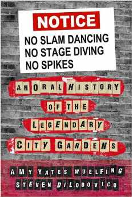 No
Slam Dancing, No Stage Diving, No Spikes: An Oral History
Of The Legendary City Gardens, by Amy Yates Wuelfing and
Steven DiLodovico (DiWuelf Publishing) No
Slam Dancing, No Stage Diving, No Spikes: An Oral History
Of The Legendary City Gardens, by Amy Yates Wuelfing and
Steven DiLodovico (DiWuelf Publishing)
I’m not a huge fan of oral histories but having the
participants of the story tell the story works particularly
well for City Gardens, the warehouse-like venue in Trenton
that served as a major tour stop (as well as a launching
pad for local bands) from the late Eighties to mid-Nineties.
Authors Amy Yates Wuelfing and Steve DiLodovico compiled
dozens of interviews to detail the story of the club and
the scene surrounding it chronologically (organized by particularly
memorable shows.) You’ll find quotes from rock notables
like Henry Rollins, Ian MacKaye, and former CG bartender
John Stewart interspersed with remembrances from the bartenders,
security people, photographers, local musicians, and regulars
who turned City Gardens into not just a venue but the hub
of a vibrant scene, stuck rather unexpectedly smack in the
middle of an urban ghetto somewhere between Philly and Manhattan.
If you want stories about the Replacements or Green Day
or New Order, you’ll find them here, along with tales
of debauched 99 Cent Dance Nights and brutal Hardcore moshpits,
Industrial noisefests and skanking Ska shows. At the center
of the insanity you’ll find Randy “Now”
Ellis, the promoter, booker, and indefatigable ringmaster
of the City Gardens circus, without whom none of this would
have happened. The book will serve as a nostalgic keepsake
if you were there, or a historical artifact if you missed
it, but either way, you’ll be engrossed and entertained.
 A
MAN CALLED DESTRUCTION: The Life & Music of Alex Chilton,
From Box Tops To Big Star To Backdoor Man, by Holly George-Warren
(Viking) A
MAN CALLED DESTRUCTION: The Life & Music of Alex Chilton,
From Box Tops To Big Star To Backdoor Man, by Holly George-Warren
(Viking)
If someone wrote a movie about a character like Alex Chilton,
nobody would ever believe it: A teen idol at sixteen, a
musical genius fronting a brilliant but commercially unsuccessful
band in his prime, years of isolation and menial jobs, and
finally a rebirth, resurrection, and reappreciation as one
of the premiere musicians of his generation. Music journalist
Holly George-Warren has done a fastidious job in collecting
a remarkably detailed, almost day-by-day account of Chilton’s
life, from his heady days as the mop-topped singer of the
Box Tops to the frustrating but artistically overachieving
accomplishments with Big Star. You’ll learn about
his unheralded but significant role in the early CBGB’s
punk scene, as well as anecdotes about latter day acolytes
(like the members of the dB’s) finding him sweeping
floors and washing dishes in New Orleans. George-Warren
doesn’t pull any punches; friends and family of former
Big Star bandmates Andy Hummel and Chris Bell won’t
appreciate her frank appraisal of their foibles and falling
out, and Chilton himself often comes across as self-destructive
and immature (and, in his later years, as an unrepentant
sellout gladly cashing in on nostalgia for his Box Tops
and Big Star catalog.) If there’s one problem with
George-Warren’s encyclopedic scope here, it’s
that the book often reads like an encyclopedia; it’s
dry when it should be passionate, and while you get a sense
of the man, you really won’t get a feel for Chilton’s
music (both the good and bad; anyone remember “Volare?”)
unless you’ve already heard it. Still, Big Star’s
considerable fanbase will gobble this up.
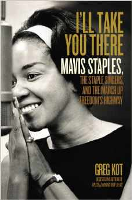 I’LL
TAKE YOU THERE: Mavis Staples, The Staple Singers, And The
March Up Freedom’s Highway, by Greg Kot (Scribner) I’LL
TAKE YOU THERE: Mavis Staples, The Staple Singers, And The
March Up Freedom’s Highway, by Greg Kot (Scribner)
As the music critic for the Chicago Tribune, Greg Kot chronicled
firsthand Mavis Staple’s remarkable comeback from
near obscurity when she was championed by the likes of Bob
Dylan, Ry Cooder, and Jeff Tweedy in the ‘00’s.
But there’s so much more to her story, and Kot delivers
all of it, from her family’s roots in the rural south
to the Staples Family Singers’ entrance into the world
of gospel music, to the family’s important role in
the Civil Rights Movement of the Sixties, to their unfortunate
collision with disco in the 70’s. At every turn, the
Staples seem to bump into history, whether it’s growing
up with in rural Mississippi with Mahalia Jackson or moving
to Chicago and befriending the young Aretha Franklin, becoming
part of the legendary Stax/Volt hit machine, or allying
themselves with Dr. Martin Luther King Jr. and Jesse Jackson.
As a music critic, Kot not only nails the story, but provides
a real feel for the music as well: How Pops Staples’
tremolo guitar and Mavis’ deep voice revolutionized
gospel music, or how they managed to meld gospel, folk,
and blues into their own signature sound. Kot’s detailed
dissection of how the Staples’ biggest hits were assembled
in the studio bears special mention; you feel like a fly
on the wheel as these historic records slowly come together,
with a list of artists, producers, and record executives
that could fill their own wing of the Rock N Roll Hall of
Fame. Most importantly, Kot will inspire you to go back
to the music, and hear for yourself the Staples’ and
Mavis’ unique contributions to gospel, blues, R&B,
and folk, whether it’s their groundbreaking reinterpretation
of “Will The Circle Be Unbroken” or their rainbow-hued
version of the Band’s “The Weight.”
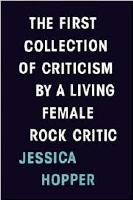 THE
FIRST COLLECTION OF CRITICISM BY A LIVING FEMALE ROCK CRITIC
by Jessica Hopper (Featherproof) THE
FIRST COLLECTION OF CRITICISM BY A LIVING FEMALE ROCK CRITIC
by Jessica Hopper (Featherproof)
It’s sad to think that Brandon Stosuy and Jessica Hopper
– fortysomethings now ensconced in top editorial positions
at Pitchfork.com – represent the last generation of
music journalists who will have been trained in print. Both
got their start writing for fanzines and moved on to professional
careers. This isn’t really the first collection of music
criticism by a woman (Lillian Roxon’s 1969 Rock Encyclopedia
holds that honor, I believe,) but Hopper’s making a
point here. There have been female music biographers, but
few collections of actual criticism. Hopper’s a great
place to start because her writing has always revolved around
her feminism and many of the best pieces in this collection
focus on that topic, like her classic piece on the inherent
misogyny of emo, her landmark piece on R. Kelly’s sordid
sexual peccadillos, or her diatribe about Tyler, The Creator’s
sexism. Her feminist perspective is also welcomed in her examinations
of artists like Lana Del Rey, Miley Cyrus, Taylor Swift, and
Lady Gaga, (Featherproof) by Jim Testa
back to jerseybeat.com
l back to top
JerseyBeat.com
is an independently published music fanzine
covering punk, alternative, ska, techno and garage
music, focusing on New Jersey and the Tri-State
area. For the past 25 years, the Jersey Beat music
fanzine has been the authority on the latest upcoming
bands and a resource for all those interested in
rock and roll.
|
|
|


 DEADFELLAS
by Jon D'Amore (
DEADFELLAS
by Jon D'Amore (


 |
|