

by Jim Testa
Fugazi, Green Day, Bouncing Souls… Those are a few of
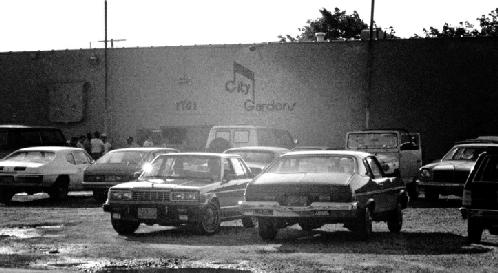
the bands I remember seeing at City Gardens, a barn-like dance
and rock club in Trenton that for years played host to some
of the biggest rock, goth, and industrial bands of the Eighties
and Nineties. It’s long gone and largely forgotten,
but my good friend Amy Wuelfing and her writing partner Steve
DiLodovico have been working on the idea for a book commemorating
all the shows and insanity that went on at City Gardens. It’s
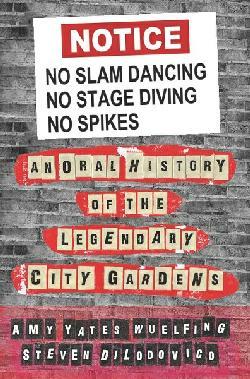
called No Slam Dancing, no Stage Diving, No Spikes: An
Oral History of City Gardens, and there’s currently
a Kickstarter campaign to help complete and publish the book.
We talked to Amy and Steve and got all the dirt. If you’d
like to contribute, there is a link at the end of the story
to their Kickstarter page with all the info and cool swag
being offered.
Q: For anyone who wasn't there, what was City Gardens
and why do you feel it's culturally significant enough to
be documented in a book?
Amy: While most people who are into alternative music know
CBGBs and 930 Club, I think City Gardens is significant
because it wasn't located in a big city. It was a big club
in the Trenton ghetto, in the middle of nowhere, yet enough
people went to support it for 15+ years. The promoter booked
dozens of bands who later on went to be huge: R.E.M., Nirvana,
Soundgarden. But more than that, it was a place for misfits
from the suburbs to come together. Before social media,
people who felt like outcasts had nothing. City Gardens
was a place where you go and be yourself. Some people went
to the club for show, others went for dance nights, but
it was a great diverse crowd.
Steve: It was one of the last musical eras before the huge
wave of technology took over. So much happened at City Gardens
that wasn't documented, and by the time it ended in the
90s we were just starting to have all these ways of documenting
things. Back then just having a VHS video of a show was
no small feat, especially if you went to shows in the '80s.
A lot of places didn't even let you bring cameras in to
shows. All we had were stories told and re-told by older
brothers, cousins, etc. I think it's important to prreserve
some of that oral tradition.
 Q:
I know this project has been germinating for some time.
When did you and Steven first begin kicking around the idea
for the project? Was there anything in particular that inspired
you to move ahead with the idea? Q:
I know this project has been germinating for some time.
When did you and Steven first begin kicking around the idea
for the project? Was there anything in particular that inspired
you to move ahead with the idea?
Amy: I have been working on this book off and on for about
15 years. Doing an oral history is a very daunting process,
as you have to track down and interview many people, you
can't just write a narrative. It's very exhausting meeting
with people, transcribing interviews, trying to make sense
of certain events. I had pretty much given up on the whole
thing until I met Steven. We met over the internet, of course.
At the time, he was living in the South, and thinking about
writing a book about City Gardens. I suggested we join forces
and he got me energized about the project again. What's
great is that he went to the club steadily in the early
'90s, when my attendence started to trail off. Our time
there covers almost the entire span of the club - and his
perspective is entirely different than mine. It's a great
combination. And I am really thankful that Steve and I met
- he really made this possible.
Steve: I happened into the whole thing quite by accident.
Amy had already done the lion's share of the research by
the time I had met her. I was inspired by what she had already
accomplished by herself to try and do whatever i could to
keep the project going. The first time I read her account
of the Butthole Surfers mayhem I was hooked and I practically
begged her to let me be involved.
Q: Do you remember your first City Gardens show?
What was it, how old were you, what kind of impression did
it make?
Amy: I went to see the British punk band Toxic Reasons on
a Wednesday night and there was no one there. Even so, I
though the place was heaven. It was a very accepting atmosphere.
As a single female, I could go by myself, dance by myself,
watch the bands by myself and no one would bother me. If
I wanted to talk to people, I could, but it was a very non-judgmental
place.
Steve:I was 14 the first time I went there. Saw Danzig.
He signed my Misfits records after the show and signed my
super-tight rocker jeans "EVIL IS...GLENN DANZIG!"
And he meant it, too.

Q: I know you were quite involved with the music
scene that revolved around City Gardens, even so far as
letting touring bands crash with you. What are some of your
favorite memories? Best shows? Any good anecdotes from those
days?
Amy: Being around punk bands at City Gardens taught me
many life lessons, but I remember one in particular. In
1984, I was interviewing many punk and hardcore bands for
the magazine Hard Times. Never had a problem, except for
the Butthole Surfers, who were tripping so hard they could
barely talk. Even so, they were still nice about it. And
then, I met Flipper.
Even among fellow punks, they had the reputation for being
a bunch of assholes, and on this night they lived up to
it. They were accused of trying to steal the opening band,
Scornflakes', equipment, which they denied. After the show,
another woman and I were sent to the dressing room to do
the interview. The band seemed nice enough, if not totally
drunk, but then something set them off. I believe we asked
them, in a joking way, about the alleged equipment stealing.
The next thing I know I’m in a shoving match with
Bruce from Flipper. It ended when he grabbed me by my hair
and attempted to throw me down a flight of stairs. I punched
him the balls, which seemed to have shockingly little effect,
but it was enough for him to let me go. My friend and I
got out of there, went to car and looked at each other like,
what the hell just happened? It was like petting a friendly
dog who all of the sudden snaps at you for no reason.
Hard Times editor Ron Gregorio saw them at Maxwell’s
in Hoboken two nights later. The band said that they had
no memory of anything that happened. Surprise, surprise.
Even weirder than the fight with the band was the lack of
commiseration I got from everyone about it. My own mother
told me I should have known better then go to drunk band’s
dressing room—which was probably true—and the
magazine’s editor told me to toughen up. I learned
there’s no whining in punk rock.
Steve: For me City Gardens was this mythical place. I grew
up in Philadelphia and that's where I went to shows mostly.
I had heard of City Gardens (and its reputation) long before
I ventured over there. I was surprisingly blown away by
Jane's Addiction in '88, that was an amazing show. Also,
the night the Afghan Whigs played there; the night Kurt
Cobain killed himself. It was really intense.
Q: Just so people understand why they're donating,
what exactly is the purpose of the Kickstarter and what
will the funds be used for?
Amy:The bulk of the money will be used to print the book,
in both hardcover and paperback. That alone is about $14k.
To have the book designed for print and download is another
$5k. We are also having a professional editor proofread
the manuscript. And please be aware that 8-10% of the money
raised will be paid in fees to Kickstarter and Amazon.
Steve: Kickstarter is a great platform for independent
projects to see the light of day. In our case the funds
we receive through kickstarter will pay for the actrual
printing of the book; the manufacturing costs. This way
Amy and I can creatively control every aspect of the project.
We are beholden only to the people who are most passionate
about seeing the project realized: the people who donate.
Q: What's the difference between No Slam Dancing
and Riot On the Dance Floor?
Amy: There was a Kickstarter campaign for the documentary
film Riot on the Dance Floor, which is a different
project than No Slamdancing, No Stagediving, No Spikes.
Simply put, Riot is a film directed by Steve
Tozzi and No Slam Dancing is a book by Amy &
Steve. Riot on the Dance Floor reached its targeted
goal and is currently in the final stages of production.
It should be completed by the end of the year.
While both projects share many similarities and overlap
in many places, there are very distinct differences. The
main difference is the focus of the narratives being told.
While the film does include a lot of Trenton and City Gardens’
history, its main subject is the story of promoter Randy
Ellis. The book being written by Amy and Steve focuses intensely
on the club itself—dates and details of some of its
most important events, personal stories and anecdotes, and
what the club meant to people.
Q: Here's your chance to make your pitch: Explain
why this is important to you and why it should be important
to the people reading this.
Amy:We have done well over 100 interviews and along the
way have talked to Henry Rollins (a onetime Trenton resident),
Daily Show host and former City Gardens bartender Jon Stewart,
Dean Ween, Ian MacKaye, GWAR, Al Jourgenson (Ministry),Gibby
Haynes (Butthole Surfers), Harley from the Cro-Mags, City
Gardens promoter Randy Now, plus a lot of the people who
went there.
Besides all the music, what so many people remember is how
City Gardens changed their lives; it made many lives better
and may have even saved a few. Attending those shows and
dance nights made a lot of outsiders and odd socks feel
like they were part of a community - accepted and free to
express themselves. Over the years, patrons had different
perceptions of, and relationships to, the club and what
went on there. People who went there in the beginning saw
things differently than those who started going in later
years. We worked hard to document it all.
No Slam Dancing is different from other punk history
books, in that the story of ‘80s and ‘90s punk
is told through the lens of one club and the experiences
of those who worked, played and gigged there. Other books
compile already-completed interviews or give “history”
from one person’s point of view; this book will be
an oral history from the people who created a sub-culture,
supported the bands and the club and made those shows happen—and
all the drama and gossip that entails.
Steve: For a lot of people City Gardens was a huge part
of their lives. And, for a lot of people it was all they
had. For me it represents a great time in my life. Made
a lot of good friends, saw some amazing shows. I just want
to honor that by doing what I can. If you were there you
understand.
For more information, visit No
Slam Dancing, No Stage Diving, No Spikes' Kickstarter page.
JerseyBeat.com
is an independently published music fanzine
covering punk, alternative, ska, techno and garage
music, focusing on New Jersey and the Tri-State
area. For the past 25 years, the Jersey Beat music
fanzine has been the authority on the latest upcoming
bands and a resource for all those interested in
rock and roll.
|
|
|





 |
|