The Indestructible Electric Frankenstein:
How To Survive Forever, And Other Useful Tips
Interview and photos by James Damion / Unite Zine
I first met Sal and Dan Canzonieri when I was 16/17
years old. By that time Sal (ten years my elder) was already
a Punk Rock legend with both his record store and the band
The Thing. Years later while living in Hells Kitchen, I
reconnected with them once again through their band Electric
Frankenstein. Their live sets at places like CBGB's, the
Continental and Coney Island High always left their mark.
The energy and the power of the music more than lived up
to the name. Like that line from Goodfellas "He might
have moved slow, but he didn't have to move for anybody."
Forget about image. The music did all the talking. Though
I still see Sal and Dan on a regular basis. we've yet to
really sit down and talk about the band and the music. That
is until now. Looking back to that night in Union City at
their studio, there were moments during our conversation
when my eyes were so wide open I thought they would pop.
My jaw so locked I thought if I didn't close it soon I'd
be charging flies rent. Sal is a pretty intense guy. Anyone
looking to start a lasting band should read this interview
over and over again. There is a lot to be learned. Ladies
and gentlemen I give you Electric Frankenstein. - JD
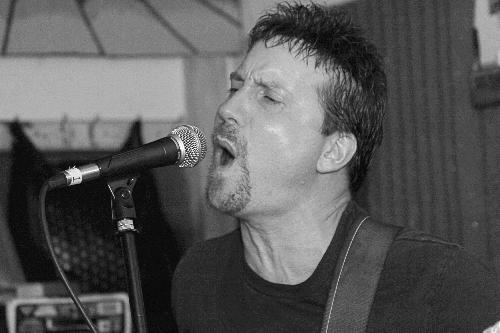
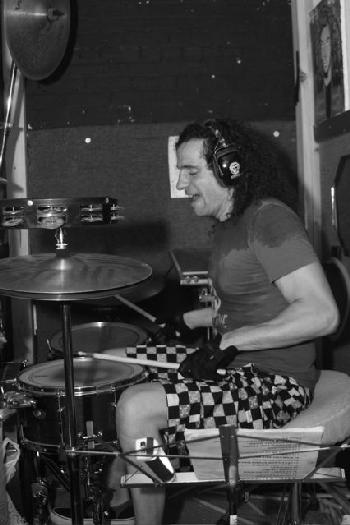
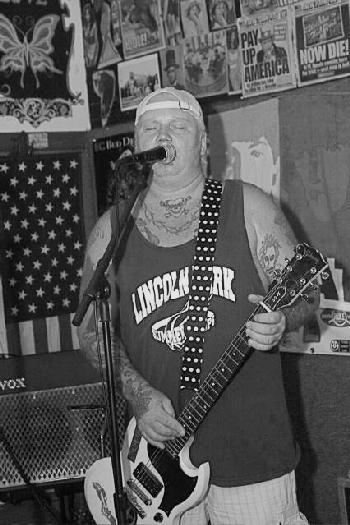
Electric Frankenstein is Steve Miller (vocals, lead guitar,)
Sal Canzonieri (rhythm guitar), Dan Canzonieri (bass), Rob
Sefcik (drums), with occasional appearances by Joe Martin
(ex- Kill Your Idols), John Steele (ex-EF), Chris Lyn, and
Bill Gill.
DAN
Q: Last week the original lineup got together
for a show at the Clash Bar in Clifton. Was it difficult
getting everyone together for the event?
Sal: It wasn't difficult at all. I asked everyone if they'd
be into doing the show and they were all for it. We got
together and practiced three times and we were ready. Everyone
remembered the songs and by that third practice we knew
we were ready.
Steve: Everyone from the original lineup remained friends.
One of them (Dan/Bass) just happens to be Sal's brother.
Q: Dan has been in and out of the band throughout.
Has it been mainly due to the obligations of work and family
or could it be that Brotherly riff that seems to be so prominent
throughout Rock history (Kinks, Beach Boys, Black Crowes,
Oasis)
Sal: No, there was never any problem with Dan at all. He
has family and work responsibilities. We've had the same
situation with our drummers in the past. John was in and
out of the band since the beginning. Every three years he
would switch up with Rob. When it wasn't them we would fill
the spot with other people.
Steve: Then we got Mike (present at the time) who's wanted
to be in every single NYC band out there (laugh). Mike is
also the drummer for The Victims and other bands.
Q: Twenty years is a long time for a band to be
playing together, longer than most marriages and friendships
last. What do you attribute to the bands success and longevity?
Sal: Everybody in the band is a fan of music. Each one
of us loves music. We were all going to the same shows before
we even knew one another.
Steve: We love the music so much that we want to play and
create it. If I had the opportunity to play in a band I
wanted it to be in a band like this, a band that tours all
over the world. Not a band that plays in the same town week
after week.
Mike (drums): This is a dream for me. I'm playing in the
kind of band I wanted to be in as a kid. We love and trust
each other. We don't fight at all. There's nothing to fight
about because we're on the same page.
ROB
Q: How do the obligations of work and family coexist
with touring and playing shows around the world?
Steve: We find ways to work around it.
Sal: In the beginning we had a lot of record companies
coming to us saying "We could make you the next AC/DC."
My reply would always be "Pay Us. Don't just say it.
Make it happen. These people want you to do a show at two
hundred bucks a night for a year to actually show them something.
You have to do things your way. We just got booked in Vegas
and that festival's sold out. That's without major label
support.
Q: Over one hundred releases, that's a staggering
amount no matter how you look at it.
Sal: It's been easy putting out that many records. They've
been released in fourteen different countries. When I was
a kid there was the English version, the French version,
the Dutch version etc. and they were all different. That
changed somewhat in the Nineties with worldwide distribution.
But that fell apart in recent times for the music industry.
Every country has a label that asked me to do a record with
them. Specialty shops would order them and say what records
they wanted. It's for collectors and that market. That's
what's kept us popular and alive since day one. Any record
store you go to whether it be Taiwan, Beijing China, the
Philippines. Wherever you go, no matter what record store
your in there'll be at least one Electric Frankenstein record.
So mission accomplished. That's what I wanted.
Q: With all the material you have available How
do you manage to keep it fresh. How do you assure that each
record doesn't sound like the one before or the one after?
Sal: None of them sound the same. Each one is a lot different
from the other. The reason is each one of us has a wide
interest in music. We all like Punk Rock, Prog Rock, Hard
Rock. I like Death Metal, Steve likes Hair Metal and it
goes on and on. Everyone brings in a different element and
it shows up in the song writing.
Steve: That's another thing. We all get along and we all
have a say. No one comes in and says, "This is how
the song goes and everyone has to sound like this. We all
come in with different pieces to help build the puzzle.
(to build the Monster) That's why we describe the sound
as Dead Boys meets AC/DC. It's a merger of different parts
and ideas.
Q: How much of your back catalog is still available?
Sal: Just about everything sold out. With the exception
of the new stuff that's just come out, I've been approached
by a few people to do box sets of all thirteen albums. In
between the albums were EP's, live records and stuff like
that. The new stuff I mentioned is "The Best of Electric
Frankenstein" which features eighteen songs. It has
a cover of AC/DC's 'High Voltage' and at least one or two
songs from each album and ends with a new song that's not
on any of the previous albums. Also, a split LP with The
Hip Priests from the UK.
Q: How are you keeping up with the changes in the
way music is being delivered?
Sal: We stay ahead of everything. We were on MP3.com first
where we were able to get huge. We also helped all theses
other bands hop on there. Taught bands how to talk to people
and make it work. I was selling records online from the
very beginning. We were using computers and the Internet
from the very beginning. We were the first to do a lot of
things and take advantage of new outlets.
Q: How do you manage to stay ahead of the times?
Sal: I've worked in every aspect of the business since
I was fifteen. I owned a record store. I managed bands,
worked in publicity, and wrote for magazines. I released
bands records. I was also in another band that played in
England and was on the BBC. Over time I learned from my
mistakes and I made sure they weren't repeated. Another
important thing is talking to people. Learning from others.
I also had advisors on how to keep your head above water.
It's overwhelming at times. How many hundreds of blogs can
you be on at the same time? How many hundreds of companies
are willing to sell MP3's of our songs?
STEVE
Q: What are you doing to celebrate the twenty-year
anniversary?
Sal: We did that one show at the Clash Bar with the original
lineup the other night.
We're also getting offers from Texas and a few other places
to do a few dates. We'll see what happens. You know how
it goes. "Money talks". We're headed to Las Vegas
next week and a festival in Minneapolis. We've also been
asked to play Dubai in April. We're releasing "The
Best of Electric Frankenstein" and the split with the
Hip Priests from England. We've got a DVD coming out in
2011. There's this cycle for Rock n' Roll that's been going
on 1955, 1966, 1977, 1988 and 1999. 2011 will be the next
big return of Rock N' Roll. There are all these new kids.
The fans that are forty and up have kids who are turning
twenty-one. That means in 2011 a load of new kids going
to the bars. Then there are the parents who are taking their
sixteen and seventeen year olds to shows with them. Those
kids are going to be starting their own bands. Since it's
a bar scene you don't see a lot of those bands because where
are you going to play when you're not twenty-one?
Q: Has merchandising been one of the keys to the
bands survival?
Sal: (Laughs) Sometimes the shirts out sell the records.
We have comic books, art books, poster books, a tattoo book,
buttons, stickers, magnets etc.. (Ten different singles
each year from all different countries.) We have vinyl,
CD's, digital and the DVD that's coming out. Someone came
up to me the other day "Do you know what a bitch it
is collecting EF stuff. I'm just collecting vinyl and I'm
still not done." Look at Kiss, The Misfits, Alice Cooper
and AC/DC. Those were bands we were really influenced by.
They did a ton of merchandising. I wanted to prove that
we could do that on a smaller scale without major label
support. Motley Crue is a great example. They printed their
own shirts, did their own publicity. Their label didn't
want to do shit for them. They did it on their own. Personally,
I learned a lot from them.
Q: Does the monster and the image ever over shadow
the band and the music?
Sal: No, because the Electric part of it always comes into
play. Electric Frankenstein represents a lot of things.
In the guitar world an electric Frankenstein is a mix of
a Fender and Gibson. They mix together different guitar
parts. In the sex world that's what they call Transvestites.
There was also a club in the mid sixties called the Electric
Frankenstein. In our music we took the sound/structure of
AC/DC and mixed it with the urgency of Dead Boys style Punk,
who had the name Frankenstein and we added the electricity
of bands like AC/DC to form Electric Frankenstein.
There was also a club in Milan during the 1960's by the
same name. Turns out there was also a band called Electric
Frankenstein from the 1970s (not the Italian one that had
one album in the late 1960s). The band has a song by the
same name. I had heard it and wanted the record a cover
of that song so bad. Someone on WFMU had played it for me.
I was looking for the record and was willing to pay up to
five hundred dollars for it. They said they would transfer
it to CD for me and when I went to pick it up a month later,
someone had stolen the album. There was a band in Belgium
called Frankenstein in the 70's and there's a newer band
out there called Frankenstein. When we were really popular
in the 90's a band titled their album "Electric Frankenstein"
which pissed me off. There was also a band making believe
they were us but I shut them down. The really dumb part
of it was they were saying they were us but they were kids
in there twenties. They claimed they were also the EF from
the sixties and had even booked some shows. It was ridiculous.
Q: How hard is it for a band to stay on top of
the business end of things?
Sal: Most bands disappear because they can't do it. If
you can't do it you're going to have to hire someone to
do it for you. I've seen so many fantastic bands that only
last for a matter of months. I used to go out every night
here and all over the country and check out bands that were
amazing. "You guys are great. We can put your songs
on our Fistful of Rock & Roll comp." They'd put
out a record and in a matter of months disappear. They didn't
know how to make records or build a following. They would
put out a single, make only a hundred copies and then go
on tour. How stupid can you be? That means one person for
every five states has your record. How can you go on tour
while no one has your record?
Sal: The dedication you put into your music means you respect
and love it enough that you're going to work at getting
it out there for people to hear it. Are you just going to
make something and say "I hope people come." Steven
Tyler said, "If you're going to be just an artist,
go play at the coffee house." If you're going to be
professional you have to get your music out there for people
to hear." These days you can get popular first and
then play out.

SAL
Q: You've been around long to enough to see a lot
of the successes, failures and missteps of Punk and music
in general.
Sal: One of the main problems is they start becoming hippies
and they get into the drugs. That's when they lose all of
their focus. If every one in the band is on heroin, how
in the hell are they going to make things happen?
Another thing is they go to major labels too soon. Look
at the Briefs. They were getting really popular. They jumped
to a major label and the label signed them just to get rid
of them. Bands don't understand why they're getting signed.
A good example is Sweet Lizard Illtet from Hoboken. They
were the Jersey version of the Red Hot Chili Peppers. The
same label that carried RHCP's signed them and made them
disappear. The same thing happened to the Supersuckers when
they signed to Interscope. The album never came out. I had
to help them get out of their contract. They signed them
and said "We want you to sound like The Goo Goo Dolls."
they said "If you want the Goo Goo Dolls., get the
fucking Goo Goo Dolls!" So they recorded their album
and were forced to overspend. They had to try really hard
to spend about forty thousand and the label said "No,
you have to spend one hundred and fifty thousand."
That and it still didn't sound like the Goo Goo Dolls. Do
you see the idiocy of that? The major labels are a bunch
of dorks. If they were any good they'd be selling a lot
more records.
They flat out lie about things too. Remember when they
said that Marilyn Manson sold sixteen million records? They're
not selling sixteen million records. They're shipping that
amount. Then record stores return them all after they count
them as sales. I know a lot of ways that they lie. By the
way, the first Electric Frankenstein record was a demo for
Columbia Records. (CBS at the time) The record that's on
"The Dawn of Electric Frankenstein".
What they would do is.. When the record would ship to the
stores the scanner doesn't read the price. It reads the
amount of units scanned. They would scan all the copies
that were shipped to them and then ship them back. For instance
when Mariah Carey was with Tommy Mottola she thought she
was selling millions because she didn't know how the system
worked and that records were being scanned that way. When
she got divorced and left his label, and went to the next
label. She saw that the numbers to her sales were all fake.
She felt she had nothing to believe in, nothing to stand
on. That's when she had the nervous breakdown.
They never sell as much as they tell you. The record labels
are never as big as they allow you to believe. That's why
none of the bands ever get paid. It doesn't make sense any
more. It's 2010 and they're operating on a 1940's system.
They're a bunch of vampires working as the mafia. Now they
have the 360 system, where they own everything about you
including your name.
So if your band is so good. Why do you need them? Fuck
them! You can make a hit record on You Tube. Then there
are My Space bands. They may only be popular on My Space,
but who cares. I know a band that sold one hundred thousand
records on My Space. Think about it. If you sell a hundred
songs a day, soon enough you'd have sold a hundred thousand
records...
One of the things that sucks about the music business these
days is. After the success of Nirvana in the 90's a lot
of kids thought "Oh, if they can do this. I can do
this." No you can't. It's not true. Nirvana was a great
band. They wrote great songs. But it created this music
lottery. These college kids thought. "I don't want
to work when I graduate." Bands like the Strokes who
had rich parents went and got lawyers, put their money together,
spent it on publicity and promoted the hell out of it. They
are professional bands filled with a bunch of college kids.
That was what a lot of the 90's indie scene was made up
of. Kids who didn't want to get a job when they graduated.
What ruined it for the bar/club owners was, half the audience
was on stage. The people who used to be part of the audience
buying beer and buying tickets. Now they don't make any
money because they have this flood of shit bands that maybe
ten people come to see. When I was going to shows regularly,
I went to see every band on the bill because I didn't want
to miss out if one of those opening bands was good. Fast-forward
to this era and nobody is showing up to see the opening
bands.
Q: You bring me back to a time when the Major Labels
were signing a lot of bands that had survived for years
independently. They would sign with a gleam in their eyes
but like clockwork would disappear after one record.
Sal: They literally sign these bands to make them disappear.
They want to eliminate the competition. Interscope was big
in that. The president of the company bragged about it.
"I control what people want to hear and that's it."
"Trends don't happen anymore until I decide."
He had a big fight with Courtney Love about that. She called
him every name in the book in interviews. She was showing
them all these great bands and he said "I'm not going
to make them big." She would say "They already
are." "Not if I decide they're not going to be
on the radio." They would pay people off. They lost
a lot of power because of people finding out about these
things. Now they're just shells of their old selves. Now
they have to do 360 deals and actually agree with people.
A greedy person says "I don't give a shit. I just want
to get famous." They may be great at writing songs
and getting shit played on the radio, but who even listens
to the radio anymore. People listen to satellite and internet
radio.
When EF started I had already been in a very popular band
and we were getting all these invitations to play shows.
We didn't play live for over a year into the bands existence.
What I would do is invite everybody to the rehearsal studio.
We had a listening area where we would have guests. The
band that used the studio before us would stand outside
the door and listen. I would have to push them out and say
"Get out of here." "Go steal from someone
else." We would play at the studio and eventually people
started making tapes of our sessions and bringing them to
clubs. The clubs response was "If this many people
are bringing us these cassettes, then these guys must be
great." "We gotta have them."
That got us a weekend show at CBGB's and the Continental
right away. We didn't even have to audition at any of these
places. We had all been in well known local bands. Jim Foster
had been in Adrenalin O.D. My brother Dan was in Kathedral.
The entire band featured somebody from somewhere else. It
made it easier.
Once we played those shows I started to see the jealousy
amongst other bands. So I got all the bands together and
had a meeting. I said "Look, lets all get popular together.
Let's not play at Coney Island when you guys are playing
at CBGB's and they're playing at Brownies. We can all play
one week here and the other week there together. Each band
taking turns headlining. Once we did that we created this
whole thriving scene. NYC was once again the place to go
for new music. Eventually it died out once all the bands
started touring nationally. And when the new bands came
up I said "Let's do it again." It was great. In
all, one band said "No". That was the Devil Dogs.
They were pretty big at the time. They didn't want to be
part of a scene or collective. They wanted to do their own
thing. After a short time they disappeared and the other
bands didn't.
People get greedy and they want that fame, comparing themselves
to much bigger bands out of their league. Take bands like
Aerosmith for instance. They're 1/10th of 1% of what's popularly
happening. Bands like that are at the very top. It's a steep
ladder, with millions of bands at the very bottom.
For more information, visit
www.electricfrankenstein.com and myspace.com/electricfrankenstein.
back
to jerseybeat.com l back
to top
JerseyBeat.com
is an independently published music fanzine
covering punk, alternative, ska, techno and garage
music, focusing on New Jersey and the Tri-State
area. For the past 25 years, the Jersey Beat music
fanzine has been the authority on the latest upcoming
bands and a resource for all those interested
in rock and roll.
|
|




 |
|