| |
 by Oliver Benton
Chris Wrenn lives a double life. Jersey Beat readers probably know him as the owner of Bridge Nine Records, the long-standing Massachusetts-based hardcore label. But your drunk cousin might remember him as the guy who sold him that "Yankees Suck! sticker outside of Fenway Park back in the Red Sox' 2004 dream season. 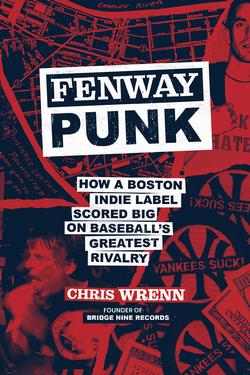
Wrenn, whose DIY label helped release such classics as Terror’s Lowest of the Low, Have Heart’s The Things We Carry, War on Women’s self-titled album, and Death Before Dishonor’s Friends Family Forever is also behind Sully’s Brand, the Boston sports apparel giant. And now, Chris has added “author” to his extensive resume' with the release of his first book: Fenway Punk: How a Boston Indie Label Scored Big on Baseball’s Greatest Rivalry, which documents both the rise of Bridge Nine and Sully’s along with his adventures in semi-legal merchandise-hawking outside of Red Sox games at Fenway Park. Fist fights, armed robbery, world tours, and the logistics of t-shirt manufacturing... It’s all in the book!
I recently had the pleasure of speaking with Chris at Bridge Nine/Sully’s homebase in Beverly, Massachusetts, which also serves as both a record store and a part-time event space that hosts local community events and intimate live performances by huge touring acts such as New Found Glory, American Nightmare, and Agnostic Front.
Q: You've been pretty busy over these past few years what with opening a brick and mortar store, getting married, and having a second child on top of running the day to day of both Bridge Nine and Sully's. Why did you decide to add "write a book" on top of everything? Is it because you're no longer sleeping?
Chris Wrenn: I definitely don’t get enough sleep! I started writing this book years before opening the record store. Really kind of half-heartedly, just kind of like jotting down memories, ideas, details that I was able to flesh out and put into the book. Probably about 10 years ago. But it wasn't until COVID and the lockdown and all that stuff where I started thinking, “you know, I really do want to document this time.”
Q: In 2015, Grantland.com did a story that focused on the more salacious aspects of the Sully's story. Did that inspire you to write the book and get the whole story out, or had you been working on it before that?
CW: Yeah, that was part of it. I was interviewed over several days for that Grantland piece. I provided some of the photographs that were used in it. Before he spoke with me, anyone else that was interviewed in that piece said, “Make sure you talk to Chris.” But there were two strong personalities involved with the article, and {the author, Amos Barshad} only had so many words he could use to tell this story, so he opted to only tell one side of it. Knowing that so much happened on our side of the story, I felt I needed to document it and put it into this book.
Q: How did you link up with your publisher, Hachette Book Group / Running Press?
CW: I was very fortunate that Nancy Barile, author of I’m Not Holding Your Coat, was one of my beta readers, and she introduced me to the editor that I hired before I had the book deal. I preemptively hired an editor to go through what I had written and give me feedback. I'm not a professional writer, and this was my first real book. So, before I showed it to people, I wanted to make sure it was in as good a shape as possible.
Nancy suggested I have a woman named Raquel Pidel edit it, and she went through it and gave me feedback on parts that weren't necessary and areas where she thought I could add some more detail. She also introduced me to a colleague of hers that was a literary agent, and he ended up taking me on as a client. He shopped it around to a whole bunch of independent and major book publishers. I got a couple of offers, and I was thrilled to accept one with Running Press and Hachette Book Group.
Q: Since this is your first book, did you develop a writing process to work on it? Did you have a set schedule for when you would write or was it in bursts whenever you found a free moment?
CW: For me, it was working on the book every morning for anywhere from 30 minutes to several hours. I just made it the first thing I did every day when I got to the office, and that really helped keep it moving along just by taking little bites out of it.
Q:Did you keep any journals or diaries from the era that the book is about that you referred back to? Or was it all just from memory?
CW: Yeah, so I didn't have a journal, per se, but I had lots of notes. I had correspondence with people from back then. I've kept everything, all the receipts. I have every invoice from 2000 on, so I knew what we were ordering, I knew what we were earning, I knew if I got a ticket by the code enforcement police, I had that documented. I have a newspapers.com subscription, so I used that pretty heavily to remind me of what the weather was like, what certain elements in Boston were like, to kind of help paint that picture. And then also just talking to people that were there. A lot of these stories, they've kind of become urban legend through the people that I know, they've been told a hundred times, so a lot of the details have been set in stone. It was a matter of going back to some of these people and saying, “hey, do you remember when this happened?” And filling in some of those details.
Q: Right, trying to be like, what is the myth versus what actually happened.
CW: Definitely.
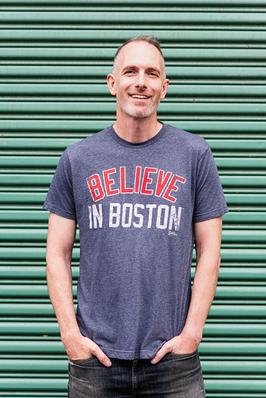 Q: Fenway Punk is three stories: the story of Boston hardcore, the story of the Boston Red Sox, and the story of the city of Boston itself over the ten years from 1994-2004. Each topic is rich enough that they can probably be stand alone books, but you do a good job of pointing out the connective tissue that links all three together. Was this your idea from the start of writing Fenway Punk or was it going to initially have a smaller focus?
{PHOTO: Chris Wrenn today, photo by Christopher Padgett}
CW: I had done a shorter piece of writing called "Bridge Nine: The First Nine Years,"" back in 2017. And that was more of the Bridge Nine story with a little bit of detail about the opportunity that we had at Fenway Park. And I always felt like, there's a thousand record labels and a thousand record label stories, and obviously there's a million Red Sox stories. But I always liked the fact that our story is the intersection of those two. I think it helped this story stand out. So, I really wanted to focus on how both of those elements intertwined. And the hope is that I've got three different audiences: baseball people, people that are hardcore fans, and people that just love Boston. I mean, who doesn't love a good Boston story!? My concern is that the hardcore fans, they're like, “oh, I don't like the Red Sox. Who cares?” Or, “I'm a Red Sox fan, I don't like punk music. Who cares?” So, we'll see. But the feedback has been really positive so far.
Q: I was going to ask, because Hachette Book Group / Running Press are kind of a big deal publisher, did they try to push any particular angles for the book? Or say, “highlight this more! More Red Sox!”? Or were they with the total vision of all three stories from the beginning?
CW: They gave me no specific direction. I worked with their editors pretty extensively to help finetune the story once I signed the deal with them. Like with my work with Raquel, there were times where they wanted to know a little bit more about something, but there was no real direction as to how to tell the story.
Q: Like other dummies, myself included, you went to art school. Yet, from reading the book, you also seemed to always have a solid mind for business. Where did that come from?
CW: I mentioned in the book when I was 13, I started my own business called “Chris's Helping Hands.” I was literally just cleaning out garages and cutting lawns and raking yards. I always liked to find ways to engage in some sort of commerce, because there were things that I wanted to buy like skateboards and music cassettes and I needed to earn the money. I was also going to my local golf course and finding golf balls and selling them by the dozen on the side of the road. When I was 16, I would go along the highways in my hometown looking for hubcaps and would sell them to a scrap yard. I was always looking to do things that could make money at the same time.
So, seeing opportunities, it's kind of like when you're a skateboarder and you're driving around, you see things that are skateable that nobody else would notice, right? You see a curb or a set of stairs, something that you could skate that the average person doesn't see in the same way. I think from an early age I had that ability when it came to making money. But to be fair, I've done things where I've lost a lot of money too! That's part of the gamble of being self-employed and being a small business owner. But ultimately having the ability to find opportunities is a strength that I've had for a long time.
Q: That's a unique way to think about business opportunities too because it’s like negative space in artwork: where are people NOT looking? Were your parents also business people? Did they influence you in any one direction?
CW: Not business people, but definitely supportive of the arts and my pursuit of studying fine art and design. My father was in computer software sales, but he’s also a painter. And the contrast with my dad is that he really enjoyed the nine to five, five days a week of his corporate job. And he once told me it was because he knew when his time was his. He knew after five o'clock that he didn't have to necessarily think about work.
I love the opportunities that I've had through being self-employed. But I've also learned that you never clock out. You are always on. You are always negotiating with yourself for your time. If I go and do one thing that's not work-related, it's ultimately at the expense of something that could be work-related no matter what. You have this give and take that I think the average employed person doesn't have which can be very, very stressful.
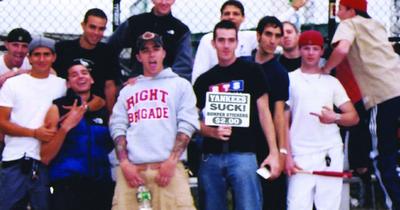
Chris and the crew on the bridge overlooking Fenway Park
Q:Speaking of business, you came up in the punk scene of the 90's when there were some goofy ideas surrounding punk and commerce, the extreme view being that "punk" should divest itself entirely from even the most ethical of business practices. How those people thought records got made and how bands were able to tour is anyone's guess. Did you ever get any grief for running a merchandise company in addition to Bridge Nine? Or were people fine with it because you were separating drunks and jocks from their money?
CW: (laughs) You know, I did have people that were critical of me and said, “well, Bridge Nine can't stand on its own. He's only able to do it because he's making money elsewhere.” And to that, I’d say, “sure.” I mean, like, I would do whatever I had to do on one side to allow for opportunities on the other. And maybe that's why we're still here after 30 years? You know, there's a lot of people that probably started a record label and focused just on the nuts and bolts of the label. And maybe they're still here, maybe they're not. But for me, it was always about trying to find money in one place and put it into what I thought was important and what mattered.
There was a sweet irony that (the money) was coming from sports fans and going into punk rock. Being originally from central Connecticut, there is a gap between punks and jocks in a lot of places, but I mention in the book how in Boston there's a lot more of a connection between people that enjoy both, which I think is great. I did grow up in the 90's as a hardcore kid and, believe me, the first time I put a barcode on a record, it broke my heart! It was really a balance. I mentioned that I do enjoy figuring out ways to make money but it's not to earn money for myself, it's to allow the thing to keep moving.
I realized recently that when Bridge Nine was really getting going, I lived in a two-bedroom apartment with my girlfriend and drove her car, and now, 25 years later, I am living with my wife and two kids in a two-bedroom apartment and I drive her car! (laughs). It's never been about putting money in my pocket, it's about pushing Bridge Nine and the artists we work with forward. I've had to figure out ways that allow myself to stick to the direction that I started and want to keep going in. If I was a super fiscally minded record label owner, I probably would be looking at more commercially viable artists and ways that I can make more money through them but, that was never really my thing. I like a niche kind of punk, and I've been able to continue doing that through these 30 plus years because I've been able to find money elsewhere.
Q: Totally! That anti-barcode thing was so weird. Like, how are labels supposed to manage inventory!?
CW: I remember when I raised 7” prices from $3 to $4…
Q: Oh, Christ! I can only imagine the uproar over that!
CW: (laughs) I was one of the first to do a couple of price increases and got a lot of flack for it! But, I mean, at the end of the day, that was the only way that we were able to keep doing things the way that we wanted to do them. And now 7-inches are, like, $12 across the board. So, it is what it is, you know?
Q: On the flipside, has being involved with punk and hardcore for so long affected the decisions you make involving Sully's? For example, in the book you mention having to pivot from selling "Yankees Suck" merch right after 9/11 to briefly selling "Osama Bin Laden: Wanted Dead" shirts to capitalize on America's immediate desire for revenge. Is that something Sully's would do today?
CW: The whole idea of Sully's is to commemorate things that happen in Boston. In the days leading up to 9/11, my friends and I were making merch that almost exclusively crapped on the Yankees and their fans. After 9/11, the entire world understandably stood with New York. We looked like the bad guys, so I started selling an old Western-style “wanted poster” T-shirt with Bin Laden’s face on it, just so I would have something to sell. Usually, it is something that happens on the field or something that happens in the city. I mean, we've made T-shirts about blackouts, crazy snowstorms. We've made T-shirts promoting a fictional fight club for Red Sox pitcher Joe Kelly, riffing on the rivalry with the Yankees. I don't think that I would make an anti-political figure T-shirt these days because I just don't feel like I need to. But we are definitely always looking for ways to commemorate Boston. Everything we made from 2000 through 2003 was just talking smack about the Yankees and I didn't want Sully’s identified as being purely negative. So, I started looking for the positive in our city and the home team, and finding storylines that we can make T-shirts about that were more positive than negative.
Q: But hater shit is fun sometimes, right (laughs)?
CW: Hater shit IS fun and, I mean, we've revisited it here and there. But you don't want that to be the only thing you’re known for.
Q: How much are you paying Ben Affleck to promote Sully's?
CW: Ben Affleck has graciously repped our brand for nothing. He's been paid in T-shirts and has been incredibly supportive over the years.
(side note: After the interview Chris shared more about the support Ben and his brother Casey have shown to Bridge Nine and Sully’s over the years including featuring merch in their movies like The Town and Manchester by the Sea. Sully’s was also asked to print the shirts that served as the wrap gift for the crew of the movie The Tender Bar, which was partially filmed in Beverly, including a scene shot in their Rantoul Street location).
Q: You appear to have a pretty deep knowledge of baseball, but in the book you admit to not knowing much about other sports when you started making shirts for other Boston teams like the Celtics and the Bruins. Has that changed? >
CW: Yeah, I definitely got more emotionally invested in Boston sports over the years. I was already financially invested, but in Boston, you become very emotionally invested. Over the years, I would follow the Red Sox more, follow baseball more. And, you know, I'm not an expert, but I definitely have found myself in a position where I can really enjoy it now. Whereas back then, it was just an opportunity.
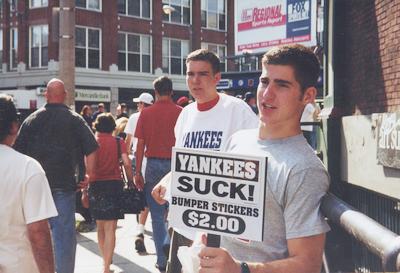
Two vendors hawking 'Yankees suck' merch back in the day. Photo by Kate Bowen
Q: Look, I'm not a fed, but you cop to participating in or at least witnessing a fair number of crimes in the book ranging from intimidation to assault to pocketing thousands in cash at the end of each Red Sox season from your Yankees Suck merch. Did you have any reservations regarding being so open about the seedy side of building your businesses? Or were you secretly paying taxes and sending out W-9's to the people who helped hawk your goods the whole time?
CW: Why do you think I waited 20 years to tell the story? (laughs). To the financial side of it, you know, we were investing all that money into something, so it became a business expense.
Q: But you didn’t run anything in the book past lawyers?
CW: No, I didn't.
Q: So, you're saying come what may at this point (laughs)?
CW: I think we ran out the clock.
Q: When was the last time you actually sold merch outside of Fenway?
CW: We had a presence there as Sully’s through 2017, so it's been almost a decade. I wasn't necessarily outside with the backpack of merch, but I would be there most nights up until 2017. We worked out a deal with the crew of vendors that sell programs to people headed into the game to sell our shirts after games for a few years but then COVID happened and things got scrambled. Since then, we've started working with Target so our presence in the Fenway area is now in the form of our own store within a store at the Fenway Target.
Q: Do you ever get the itch to throw some Sully’s shirts in a backpack, go down to Fenway, and try and make a few bucks after a game?
CW: The money back then was great, but more than just the money, it was the vibe. There's really nothing better than hanging out at Fenway on a summer night. You’ve got the stadium going nuts when something happens in the field. You've got the vendors outside. You've got a beautiful sunset. I loved making money around Red Sox games, but I really enjoyed the culture around Fenway.
Q: Do you think that's partially why Boston punk and sports are so closely connected? Because there's only one major league team in the state and also because the stadium's right in the heart of the city.
CW: I love that that whole area of the city is built around the stadium. You are right there. Obviously, that creates some inconveniences for people going to games. It's a lot harder to park around Fenway these days than it was back when I was vending. But it's the fact that there's no barrier between the fans and the stadium, you know? You just walk right up to it. It’s good for that kind of outside-of-the-park culture.
Q: Are Bridge Nine and Sully's now both financially independent of each other?
CW: Yeah, both brands are separate entities. Full disclosure, I draw more of a paycheck from Sully's, usually to allow Bridge Nine to keep doing what it does. But they are independent of each other.
Q: Many labels cite Bridge Nine as an influence, do you see the same respect shown to Sully's? I'm thinking of merch labels started by punks like MethSyndicate who are now able to almost instantly press up shirts based on viral trends. Sully's clearly set that standard.
CW: There's definitely been respect shown and it's been cool to see people that have been influenced by what we did go on to very cool things. Down at Citi Field, there's a brand called The 7-Line run by a hardcore punk fan, and he's fully licensed with the Mets. He has a presence inside of the stadium. He's been able to model his brand after Sully's but take it to even higher levels, particularly because there was more of a need for what he was creating. There was a team pride problem at Citi Field with Mets fans, so he created something that united Mets fans in a way that the team couldn't deny.
There's more gatekeeping in Boston with some of the more established brands, so it's been harder for us to have some of those same opportunities. But again, it's cool to see what we've done inspire others to do something and take it to great heights.
Q: You were also ahead of the times when you thought about bringing Sully's printing press in house rather than outsourcing. I assume that idea must still pay daily dividends? Especially now with all the tariff nonsense leading to increased costs and worldwide shipping delays.
CW: It was a great move when we did it. We have since sold our screen printing business (Liberated Images) and are now a customer of the business that I once owned just because when we moved into this space (on Rantoul Street), it didn't work. But at the time, being vertically integrated and having the ability to create merchandise on a moment's notice, the second we needed it, was a huge help for us to stay ahead of our competition and to benefit from opportunities that we might not have been able to if we weren't faster. A good example of that was the Joe Kelly Fight Club shirt in 2018. The fight happened on the field on a Wednesday night and by Thursday morning, we were printing the t-shirt and we had it at the stadium that day!
Q: Boston hardcore appears to be having another moment right now. If you ask me, it’s finally struck the right balance between the violent, goon-shit it’s been known for and bands being really active with progressive causes and working with Boston charities. What's your opinion of the current scene and was there a band you wanted to sign but just couldn't make it work?
CW: I think the scene right now is as good as it ever has been. I think it's incredible the number of bands that are out there saying important things. The number of releases that are coming out of the Boston- area is also incredible. Obviously, venues are always touch and go depending on what's available and what stays open, and there's always people that look back and say it was better whenever, but I think it's as good right now as it's ever been.
In terms of bands, I mean, not to name any names, but there's definitely a lot of bands that you want to work with that you either don't have the opportunity to or the timing isn't right. I've said “no” to bands that I regretted. I've said “yes” to bands that didn't really go anywhere. As an independent label you can only do so much, so there's definitely things that I've had to pass on. It is what it is.
Q: You make a great case in the book for the power of collaboration. At one point, Bridge Nine, Hydra Head and Big Wheel Recreation were all operating out of the same office space and you credit being able to share ideas and resources with each other as the thing that led Bridge Nine to becoming a major player in the hardcore scene. How important is the spirit of collaboration today with both Bridge Nine and Sully's?
CW: It's huge, and I think that's one of the points that if anyone takes something from this book it’s that even though I am super pro ‘do-it-yourself’, ultimately that really just means ‘start it yourself.’ You're going to need to surround yourself with people that can help you create the opportunities that you want to create. Network. Put yourself in the same room with other people. That's why we try to have events at the Bridge Nine record store because we want to be a cultural hub. We want to have ideas exchanged here. We want to have introductions be made. And ultimately, many of the coolest things that I've been able to do have been because of people that helped me open those doors, or people that I met that allowed something to happen. If I depended solely on just my own efforts, I'd probably have a lot less to show for it. So, make sure you get out there; you meet people in person, you help them, they'll help you, and, collectively, you'll be able to do really cool things!
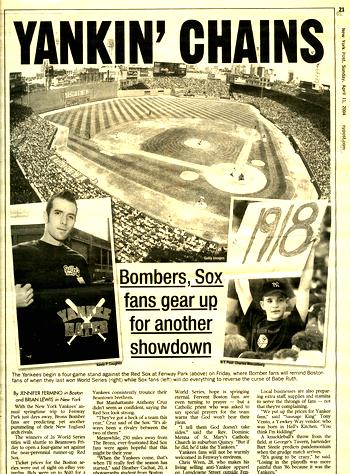
Chris Wrenn in the news during the 2004 World Series hawking a "Yankee Hater" tee.
Q: Bridge Nine is associated with straight edge hardcore but you actually have quite the varied roster from Polar Bear Club to Candy Hearts. Is every signing a reflection of your personal tastes or does anyone or anything else influence your decision when it comes to signing an artist? I will say, every time I come into the store, I swear Depeche Mode is playing!
CW: (laughs) I mean, look, I love straight-edge hardcore, but ultimately, as you grow as a label, you want to explore new ideas, you know? And while I do exist and stay in a pretty narrow lane, you do want to push the envelope a little bit because, again, after 30 years, your own personal tastes expand and what you're into evolves, and you're going to see a little bit of that with Bridge Nine. But ultimately, I want to work with artists that excite me. And so, we've been able to find something exciting with a lot of different kinds of bands. It's just a matter of finding bands that we really like and creating opportunities for them.
I remember years ago, somebody said that Bridge Nine was a “high-top, hardcore label.” But the reality is we have artists like Lemuria and Candy Hearts, and Crime In Stereo. These are artists across the whole spectrum of independent music. But we do kind of have a sound, which I'm fine with. But I would ask anyone before they count us out to really take a dive into our catalog and check things out and see that there is a lot more variety there than we get credit for.
Q: On that note, with over 300 releases on the label, in your opinion, what's the most slept on B9 release?
CW: That's the thing; I talk about batting a thousand in the book and how the idea of only succeeding four times out of 10, that's a failure in most scenarios. But in batting, it's incredible! And with Bridge Nine, I have had the great honor to release so many albums with bands that have really made a mark, but for whatever reason, there are releases that fall short in terms of general awareness. A lot of times it's because a band broke up right after the record came out, or they didn't tour enough. People need to experience you as a hardcore band in person, I think, for it to really have that connection. And so, if you write a record, and it could be a great record, but, like, nobody actually gets to experience it in person, then the level of connection is a lot lower. And so whether or not that record is relevant or still talked about 10 years later isn't always the case.
Carry On is an example of a band and an album (A Life Less Plagued) that didn't pop off the way that you would want it to. Incredibly recorded album. I think it is a perfect album. There's not a song that I would cut from it. You really couldn't because it's only, like, 19 minutes long! But it was a record that came out and the band broke up literally months later. But, thankfully, everyone in that band continued to go on to cool things. If not for Carry On breaking up, then perhaps you don't have Terror? Maybe you don't have Piece by Piece or Internal Affairs? There are a lot of Southern California hardcore bands that grew out of the ashes of Carry On. And all of those albums and all of those bands have kind of a common starting point which was ultimately Carry On.
So, for sure, it's a record that I think at the time only resonated with a small group of people. But it's one of those… it's like the ripples on a pond. That what they did in 2001 continued to resonate with people. And we reissued the album in 2011 for its 10-year anniversary because everyone in the band had gone on to very cool things. And now having the opportunity to do it again for the 25th anniversary but also have it coincide with the band performing again. I mean, everybody in that band has gone on to very cool things at a very high level, whether it's Todd having been in Terror, but now he's in Nails, or Terror putting out their 10th album and still crushing it! It took some time, but that Carry On album has been vindicated!
Q: Your daughter Georgia has seemingly inherited your spirit of entrepreneurship starting at six years old by selling her art on the streets of Salem to recently opening her own brick and mortar store there. How involved are you in her brand and how do you balance offering advice with letting her try things and make her own mistakes?
CW: I'm very involved with helping her. We started working on her brand when she was six years old. She's 14 now, a freshman in high school. It's been a long process, but it's really just been about her creative potential and just showing her that the things that I've been able to do with Bridge Nine and Sully’s are things that she can ultimately do with her brand. I offer her manufacturing advice and show her things that we could make with her designs. Then she would create designs that she felt would resonate with people that were visiting Salem.
She opened her store when she was 13 and no 13-year-old is necessarily opening their own store. But she has had the support of both of her parents and her step-parents. There's a whole village around her that has been excited about these opportunities that she's had. But, yeah, it is a balance between helping her and just seeing what she wants to do with it.
Q: To use an example from your book, if she said, “Dad, I was offered 500 bucks to fight someone in a parking lot”, are you telling her to go for it? (laughs)
CW: (laughs) I would let her make her own decisions. I would hope that she doesn't do it but, you know, opportunity knocks, right?
Q: What's coming up in 2026 for both Bridge Nine and Sully’s?
CW: For 2026 we are focusing on keeping some of our back catalog in print. Bridge Nine has a very extensive back catalog and it’s difficult and costly to keep everything available so we kind of cycle through. There are a bunch of albums that are long overdue for vinyl represses so we're going to be focusing on that this year.
Sully’s is going to focus on continuing to expand in Target. We have a great presence in Boston, but we want to see if we can do some more around the state. Also, working on our collaboration with Section 10 Podcast. It’s a brand that is run by one of my former employees, Jared Carrabis. He's a podcaster now that focuses on the Red Sox and baseball fans, and we've done all of his merchandise recently. So, we're going to continue to work on helping him build his brand.
Q: Lastly, in the few years that I've known you, you've always come across as polite, soft-spoken, and level-headed. A far cry from the young Chris I read about in the book who would get out of bed in the middle of the night to fight someone in a parking lot for a chance at making a quick $500. The stock question here is normally "what advice would you give your younger self?" But I'm more interested in knowing "how does 1999 Chris Wrenn show up in 2026 Chris Wrenn”?
CW: 1999 Chris Wrenn shows up to remind 2026 Chris Wrenn that you still need to get out there and create the opportunities that you want. That was one of the things that I did well back then and it’s easy to rest on your laurels and find a comfortable place. At 50 years old, I'm not going to be fighting people in parking lots and climbing buildings to, you know, “alter” billboards. But ultimately, the spirit of 1999 Chris remains, and I try to tap into that whenever I can.
Chris is currently on a book tour promoting Fenway Punk! Catch him at one of the tour dates below:
March 10th - Space in Portland, Maine
March 13th - Powerhouse Arena in Brooklyn in conversation with Drew Stone
March 14th - Barnes & Nobel, Glastonbury, CT
March 30th - Square Root in Roslindale, MA
April 9th - Harvard Book Store in Cambridge, MA
You can purchase a copy of Fenway Punk at Bridge9.com and Sullysbrand.com.
JerseyBeat.com
is an independently published music fanzine
covering punk, alternative, ska, techno and garage
music, focusing on New Jersey and the Tri-State
area. For the past 45 years, the Jersey Beat music
fanzine has been the authority on the latest upcoming
bands and a resource for all those interested in
rock and roll.
|
|
|
|
|





 |
|