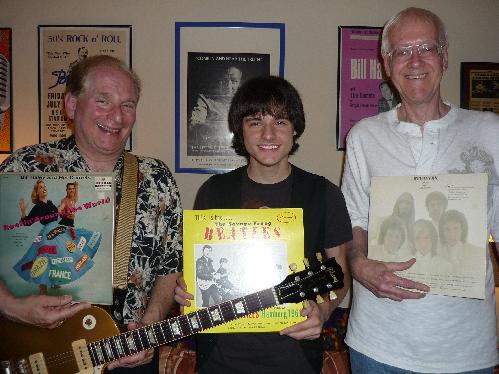
Left to right, Bill Turner, Mike Lefton, John Hawken
A Not So Brief History Of The Birth Of Rock & Roll
An Interview With Bill Turner (guitarist for Bill
Haley & The Comets), John Hawken (keyboard player for
The Nashville Teens & The Strawbs, and one of England’s
first punk bands, Third World War), and Mike Lefton (guitarist
in Rosedale, VAM with his dad Alan, and The Ruggs)
By Phil Rainone
Every once in a while you get to do an interview where
you can pretty much just sit, listen, and learn - let the
tape roll, and let the interview pretty much run on mojo.
I first met Mike, John and Bill at the Blue Moon in South
Amboy, playing at the Open Mike Nights, over the course
of about two years. Bill Turner has the finesse and firepower
that, when he hits the chords to a classic like Chuck Berry’s
“Nadine,” you stop whatever you’re doing
and either pay close attention, or grab your gal and hit
the dance floor! Bill was the guitarist for Bill Haley and
the Comets, and currently plays with Bill Turner & Blue
Smoke.
John Hawken can play big, barrel-house rock & roll
riffs, boogie-woogie, blues, or delicately intense solos,
on just about any kind of keyboard. Again like Bill, he
stops you dead in your tracks to listen, learn, and rock
out! He was part of the original British Invasion bands
back in the early 60’s, playing keyboards for The
Nashville Teens (one of their best known songs was “Tobacco
Road”), and later of the prog-rock band The Strawbs.
He was also a member of one of England’s first punk
bands, Third World War. Currently he’s been up for
just about any kind of jam he can get his hands on.
Mike Lefton in his young career, has formed two bands so
far, and can be found playing at The Blue Moon, The Brick
House, or just about any club in the area that hosts live
music, and he’s currently working on some original
songs. Besides guitar, he can play just about any instrument
he can get his hands on. He’s deep into rock &
roll, the blues, and has a thirst and desire for music that
is refreshing.
 I’ve
seen all three musicians play, and the talent and mojo that
they all bring to the table is quite amazing. First thought
about doing an interview with them I was thinking about
comparing the differences between America and England back
in the 50’s when rock & roll was first getting
started. When it came time for the interview about a year
later (we recorded for over two hours at Bill’s house,
and later I still had a gazillion questions at The Blue
Moon where we went after the interview for a few brews,
and for the guys to lay some rock & roll on the assembled
faithful), I was glad that my original idea was wrong, as
the interview went through some interesting twists and turns. I’ve
seen all three musicians play, and the talent and mojo that
they all bring to the table is quite amazing. First thought
about doing an interview with them I was thinking about
comparing the differences between America and England back
in the 50’s when rock & roll was first getting
started. When it came time for the interview about a year
later (we recorded for over two hours at Bill’s house,
and later I still had a gazillion questions at The Blue
Moon where we went after the interview for a few brews,
and for the guys to lay some rock & roll on the assembled
faithful), I was glad that my original idea was wrong, as
the interview went through some interesting twists and turns.
By the time I started to transcribe the interview, listening
closer to the questions and answers (Bill, Mike & John
were at times, tossing stories, questions, answers, and
a whole lotta laughs around the living room on their own.
There were times that I just sat back like a happy camper,
and let the good times roll), as stories of Elvis, The Beatles,
The Animals, Carl Perkins, Jerry Lee Lewis, Utube, and all-things-rock
& roll got tossed around the room like beach balls.
It was evident that my original idea of the musical differences
between the two countries had more similarities than you
would have thought…
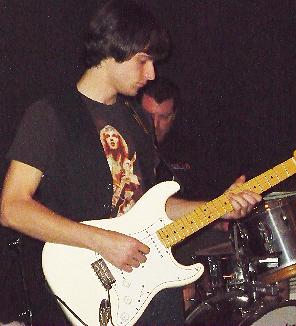 Phil:
Mike has a video on YouTube for his cover of The Beatles
“Let it Be,” when he played all the instruments,
and than put them all together as one song. Phil:
Mike has a video on YouTube for his cover of The Beatles
“Let it Be,” when he played all the instruments,
and than put them all together as one song.
John: When did you do that Mike?
Mike: A couple of months ago, I think it was in December.
I just went down in my basement, and had a video camera.
I had the song on my IPod, and I was listening to it while
I was playing a particular instrument, so that way when
you put the tracks on top of each other, it all came together,
and it sounded like the original song.
Phil: With the use of Utube these days, how does that differ
from when you guys (John & Bill), started out when you
had to record a band in a studio?
Bill: Well, the way I use to do it, the poor man’s
way, when we had to make a quick demo, I’d bring in
a reel to reel tape recorder. I’d plug it in, mike
everything, and do it that way. We’d try different
takes of it until everything sounded alright or- let’s
do it again, back off on the sax, bring up the bass, do
it that way…
John: Did you use four tracks?
Bill: I didn’t do that, we were making quick demos.
We were tying to make a model copy. We’d use the reel
to reel and make cassette copies from it.
Phil: (to Mike) How long did it take to make the “Let
it Be” video?
Mike: Well, I didn’t actually put it together. I
had a friend of mine put it together, and it took him a
couple of days to get the video just right. But speaking
of that I also did the same kind of thing but with a music
track- an audio track. I went in my basement and I just
played all the instruments, and put them on top of each
other, and compress them into one file, so it sounded like
a whole song. That took me a whole day. I recorded onto
a digital player than transferred that onto the computer,
and than I used an editing program on the computer.
Phil: (to John) With The Nashville Teens (“Tobacco
Road” was one of their big hits back in the early
60’s), how long would it take to make one song?
John: Usually about two takes, because everything was done
under a budget. Like Bill would say, we would go into the
studio called R. G. Jones in Wimbledon (England), and he
was the cheapest one around, but he was good. I think it
was four tracks, but he did everything that was necessary,
and charged something like ten pounds, and he would give
you a cassette tape. From there, if you were picked up from
a record company, in our case it was Decca, they would put
you in a proper studio, which was King’s Way Studio,
and have Mickey Most (famous 60’s producer), producing.
And he never produced a record they didn’t like, but
he was a failed pop singer. It was Mickey Most and the Gear,
and at one show that we were at, in the middle of their
act, he took off his jacket, spun his jacket around, the
band was going mad behind him, and he threw his jacket into
the crowd, and a girl in the front caught it, and went-
“Awwww!!” Than threw it straight back at him
(all of us laughing). I think it was at that point that
a light went on that it’s not gonna happen (as a singer),
so he became a producer, which was a logical step. Then
he said, I’ve got two bands, The Nashville Teens,
and he had already done The Animals, who had already done
their first hit, “House of the Rising Sun” (written
by Woody Guthrie), and again I think that was done in two
takes. “Tobacco Road,” was done in one or two
takes. In fact he did an album of ours, did ten tracks,
and did the whole thing in less than five hours. We never
heard one single playback, he’d just say, ‘It
was great guys, next track!’ Never heard a thing until
it came out and it sound like it was recorded in a hurry.
Bill: In Nashville (Tennessee) it was the same way. They
have three track machines- a left, right, and a center channel.
Now, when they’re doing “room stereo”
they have that middle channel for an extra dimension. But
for the longest time ever, the studios used three tracks
in Nashville, and they did everything that simple. It was
always great when a bluegrass band or traditional country
band came in because they’d be some new songs that
they tried out on the road. So, they’d be playing
night after night, after night, than they would go into
a studio and knock off a song in a couple of takes. In the
old days prior to that, in the early fifties, late forties,
they would rent The Andrew Jackson Ball Room in Nashville,
and Mercury or Columbia Records would bring in two track
Ampex machines, or a mono Apex, plug the mikes directly
into the machine, and the whole band would play the song
right there in the hotel room! They made some terrific sounding
records back than.
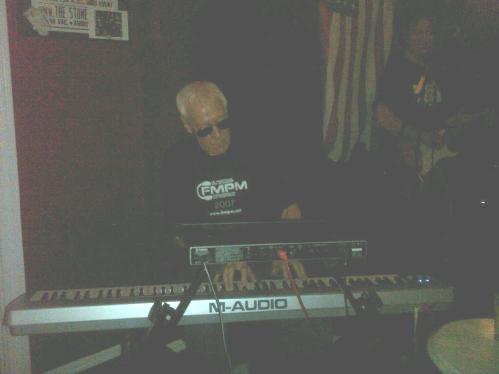
John: I hear now, that they’re getting back to recording
bands all together like they use to. You get a slight leakage
between the instruments, but it sounds real. It sounds more
natural.
Bill: These days, a lot of people are using pitch correction
left and right… I’ll tell you what’s a
smoking gun… when you look at the new CD by ( the
name of the female artist has been purposely left out, but
you can probably choose just about any Top 40 artist and
insert their name here), with all those great songs, she
actually thanks her pro-tools engineer! What a smoking gun
that is!
John: It would have been, also if she said that she thanked,
Auto-Tune! That’s the one apparently, that Britney
Spears used live (which was an embarrassing mess)!
John: Yeah, I noticed that the harmonies were a little
too perfect. You heard that human, out-of-sync that gives
it that ambience, and everything is just so, ribbon-perfect
now, it’s just a little too perfect.
John: You can say that The Everly Brothers were perfect.
Hardly a problem with their harmonies, as close as brothers
can get. That special closeness- they were spot-on. In those
days, what you heard was basically what you got, because
they had no way of correcting anything-especially singers.
So if you had bad singers, someone like Fabian (think of
Justin Bieber, but in the 60’s), who couldn’t
hold a tune in a paper bag! It became apparent to anyone
who watched him, he couldn’t hold a tune, so perhaps
they liked his hair (think Bieber again), or whatever, but
there was no way to conceal it (bad singing). Now (with
auto-tune, etc.), you have anyone getting up there and doing
it (need I mention his name again?)!
Mike: Especially with all the lip-syncing that goes on
today.
Phil; (to Bill) what year did you join Bill Haley and the
Comets?
Bill: July of 1974. I was in the band for 2 ½ years,
‘til the end of 1976.
Phil: What was that like, being in a band that was one
of the original rock ‘n’ roll bands?
Bill: It was great, until Rudi, the sax player passed away.
Easily the best sax player I’ve heard in my life!
He could sound like Lester Young (jazz sax player), and
he could get those high, high, high notes, and execute them
with perfect control. Back in ‘74 he came down with
in-operable lung cancer. Sad to say, the last night of that
tour, we were playing in France, the club was absolutely
packed, and the fans wouldn’t leave, so we had to
exit the club, going outside. We were all sweatin’-
it was December- winter- and we had to hold our jackets
closed- freezing cold, and walk around to the other side
of the building into the dressing room. Well, we all caught
a bad chill; most of us woke up sick the next day. On was
the flight home, I was laying across a row of seats with
a blanket over me. I got home and went straight to bed-and
Rudi had come down with pneumonia, and he had to go to the
medical center where he lived, in Pennsylvania- he had pneumonia.
While he was in there they were giving him tests, and they
found out that he had in-operable lung cancer. They tried
to arrest it with chemotherapy and radiation, but he only
lived until February, 1976. …We tried hiring another
sax player, and we were supposed to go on tour April of
’76 but the tour got cancelled- the sax player got
disgusted and resigned. We didn’t go back on tour
again until November of ’76, and we had assembled
a new band using local guys from South Jersey and the Philly
area. Went on tour, and the tour was pretty successful,
but at the end of the tour Haley retired. The manager who
was trying to get rid of the original band, the American
band. had a British band that he wanted to put behind Haley,
but he basically wanted to control the guy-manipulate him
(Bill Haley), and layoff the original players in the band
including myself. He eventually did that, so that’s
how sadly it ended. Haley did two more tours, one in 1979,
and one in 1980, than he passed away in February one 1981.
Ironically, five years to the day that they buried Rudi,
so he never basically recovered from the tragedy of losing
his right-hand man- left-hand man- the eyes in the back
of his head. That’s what kind of business partner
Rudi was, including being his best friend, so just never
recovered from it.
Phil: What year did you start playing with the Nashville
Teens?
John: I think the end of ’62, maybe ‘63and
we were a local band (England), and we started playing one
night a week, than two, three. The band was a great live
band, and the gigs started pouring in, than we were working
four or five nights a week. I was working in an advertizing
agency so I had to get up early in the morning, catch the
train uptown, do my thing, come back, and go out to a gig.
Si after a while I figured either the band has to go or
work has to go so, next day I went to work, handed my notice
in. Then they sent us to Germany, to play three months in
Germany, to a club where you play six hours a night, Monday
through Friday- it’s five minutes off every hour-
we played eight hours on Saturday- than did the two hour
matinee, again only five minutes off every hour- seven hours
on Sunday- than we had one hour off after the matinee! At
the end of the first week everyone’s hands were shredded-
I was playing this big old grand piano they had at the club.
The guitarist’s hand were bleeding like you wouldn’t
believe, but after about ten days, two weeks the hands healed
up - we had like metal tips for fingers! It was unbelievable!
After about two months we had about 250 songs down, because
what would happen is, you get bored playing the same songs,
so we’d come in, in the afternoon and rehearse new
songs, or rearrange old songs just to keep things fresh.
But you didn’t get much sleep; you got no money- so
we had to break into vending machines about four in the
morning. It was survival of the fittest! You were lucky
if you got a lady who’d take you home, you’d
live with her for the time being. In Germany, the following
year we played at the Star Club in Hamburg about 18 months
after The Beatles had left there. Again, it was a revolution!
Still we had no real management, we were going through agents
who took their ten percent, and we got paid pennies a week.
Again, if you could find someone to live with, you’d
manage to get by.
…Young musicians like Mike (Lefton), he’s a
great musician, I’ve seen and heard him many times-
he’s deserving of success. I worry for him because
he doesn’t have things laid out the way we did. We
had more gigs than there were bands to fill the gigs when
we started out, and that was in a little village in England.
The bands played four, five, sometimes six nights a week.
What does Mike have to compare to that, nothing.
Phil: Bill Haley and the Comets, Elvis, and the rockabilly
scene at the time in America were a big influence on punk
rock when it first got started back in the 70’s. Who
did the writing for Third World War, which was one the original
punk bands, that you were in, back in the 70’s?
John: I was always lucky to work with great song writers.
Terry Stamp (and Jim Avery) was great, from The Third World
War, Britain’s first punk band. He’s now out
in LA, and writes the most amazing tough, lyrics. “Hammersmith
Gorilla,” “Mug an Old lady Blues,” great
stuff!! But the people who loved it were the people who
had no money. We had The White Panthers, The Black Panthers,
and The Young Communists, the this, the that- who would
turn up to the gig. None of them had any money- But the
establishment was like, ‘What the hell is this!?’-
We were four years too soon (1970/71). There was still peace
and love in England, and we played mostly around London-
we did do a tour of Finland, but it was hard to take. One
critic wrote, ‘I saw this band (Third World War),
last night, and they opened up for Mountain. I think there’s
something wrong with this crowd. Everyone applauded, and
it sounded like an Austin-Martin car was being revved up
on stage! I felt like I wanted to cover myself in petrol,
set fire to myself, and throw myself off the balcony! And
I don’t think anyone would have noticed!!’ We
took that article- we blew it up, and posted it all around
London. Any publicity is good publicity! That’s the
sort of reaction we got to the band- when you listen to
his (Terry’s) lyrics, they were absolutely brilliant!
Meet The New Boss - Same As The Old Boss!
Bill: where do you go today to pay you’re dues? Disney
World? Or American Idol?
John: Where can you play your original stuff?
Mike: I find that clubs, bars, and places like you guys
use to play at, they don’t even know what live music
is any more! Phil knows, because he comes to see my open
mike nights in Sayreville, (The Brick House). We get told
every single week, “Could you quiet the music down?
Could you turn it down just a couple of notches?”
we’re not playing that loud, we’re not heavy
metal (band), shouting or screaming. But rock ‘n’
roll means that you gotta play at certain level, and the
people that work (mainly a “sports bar”), there
and the patrons, as soon as they have to raise their voices
just a little bit, they think that the music’s too
loud, and they don’t want you to play. A lot of those
places don’t even want live music. So, it’s
like, I have no place to go, there’s maybe one or
two places locally (The Blue Moon in South Amboy is a fertile
musical—Mike and his Dad Alan, and Bill and John,
play there almost every week_), where I can get in and play.
Even than they what your people to pay a cover charge, and
some places what you to “Pay to play” there.
And it’s ridiculous!!
John: Yeah!
Bill: Certain towns think they’re doing you a favor
by giving you the exposure. Any time anyone says to me that
we have to work for exposure I say, ‘Listen man, you
can die from exposure (everyone laughing)! I notice that
when you talk to clubs today they say, ‘Well what
if nobody shows up?’ What if you order a truckload
of beer and nobody drinks it? Do you get your money back
on that? If you absolve them from having to pay you, they’re
not going to do any promotion. They figure, ‘Well
if this guy wants to get paid, he’s going to do all
the promotion.’ So that will absolve the club from
doing anything!
John: In the old days the clubs did the promotion, and
you did the playing. Pure and simple as all that! They put
the ads in the paper, they get the crowd- it’s their
crowd. If you bomb they just won’t have you back again!
They’ll pay you but you won’t be back a second
time, and that’s the way it should be… You cannot
have a guaranteed financial success every night and that’s
exactly what they (the pay-to-play clubs), want! Then it
comes out of whose pockets? - The MUSICIANS!!...
Phil: Do either of you have any advice for Mike, regarding
his musical career?
John: Don’t make the same mistakes I made (laughing).
Get a good lawyer before you sign anything. Now, instead
of the large companies there use to be- Island, A&M,
Electra, etc., they have a lot of mom and pop situations,
where they say, ‘We have a record label. Which means
that they’re probably working from home, and they
can make you, ‘The biggest star in South Amboy!’-
And in Perth Amboy they haven’t heard of you! So be
very careful about signing a contract that would hold you
to them for three or four years, and everything you’re
got, they get a slice of, and you can’t go anywhere
else. So be very careful, get a proper lawyer. …And
you’re playing great! I’ve seen you play many,
many, times. That side you’ve got down- don’t
slip up and do what we did on the business side, and sign
the first thing that comes along. We did and we paid a hell
of a price for it!
Bill: It’s also good to get a personal manager. I
could have probably gone a lot further if I had good management-
I never had management. When you go to Nashville they want
you to live down there, yet the pay scale for working six
hours a night, with no breaks is like thirty dollars a man,
even today. New York managers want you to be between the
ages of 19 and 25, preferably a hip-hop singer, and preferably
female.
John: Start growing your hair Mike (laughing)!
Bill; Nobody wants to see grey hair- any of these record
labels. The market’s getting younger and younger by
new artists, which isn’t a bad thing. But the people
who run record labels today, for all they know about music,
they could be in a Dagistino’s selling meat (laughing)!
All they know about is selling, they don’t know music!
John: Music to them is just a product!
END OF PART ONE!
We had about 2 hours of the interview on tape, and we could
have gone on for a few more hours easily, but I think we’ll
leave that for part two. The stories that Mike, John, and
Bill told were fun, amazing, and at times jaw-dropping.
It was like the continuing history of rock ‘n’
roll! Besides contributing stories from his own experiences,
I think Mike (and myself), was the beneficiary of what I’d
call the Collage of Musical Knowledge from Bill and John.
Later that night, I had been thinking about the first time
I had seen Mike play. I think he was about 16 going on 17,
and he pulled out T-Bone Walker’s classic blues number,
“Stormy Monday.” During the song a guy turned
to me and said, “What’s that kid know about
playing a song like that? He ‘s still wet behind the
ears!” At that time I didn’t have a good answer
for him, but after doing the interview I now have answer
for the guy. Mike is blessed with a talent, and he, like
John Hawken and Bill Turner are sharing it with all of us.
When I first thought about doing this interview I had the
idea of comparing the differences between the birth of Rock
‘n’ roll in America and England. But after the
interview I could see that there were more things in common
with Bill John and Mike than I had thought. Their passion
for creating music hasn’t dwindled over the years.
If anything it’s more intensified and inspired, and
inspiring. That night (like a lot of nights for all three
of these guys), playing “Stormy Monday” he was
passing on to us what was given to him. For someone that
young to know and respect the past like that is awesome.
Fast forward to about a week ago when Mike (guitar), his
Dad Alan (bass), and Vinnie (drums), VAM played at the Blue
Moon. Toward the end of their first set they launched into
“Stormy Monday.” I flashed back to the first
time I heard them perform the song, and when they were finished,
I felt that they aced the song. It was straight up blues,
no chaser- all mojo!
After the interview we all headed down to The Blue Moon,
and the guys sat in on The Open Mike Night (which is run
efficiently but with a LOT of good vibes and mojo by Bobby
DeLrosso), and hoisted a few pints. Seeing these guys play
was like the cherry on top of the ice cream. They just plugged
in, turned the amps up, and played some of the best rock
‘n’ roll this side of Chuck Berry!!
Now, if you thought Part 1 of the interview was interesting,
just waits until Part 2 rocks and rolls your way in the
near future!
JerseyBeat.com
is an independently published music fanzine
covering punk, alternative, ska, techno and garage
music, focusing on New Jersey and the Tri-State
area. For the past 25 years, the Jersey Beat music
fanzine has been the authority on the latest upcoming
bands and a resource for all those interested in
rock and roll.
|
|
|





 |
|