|

by Jim Testa
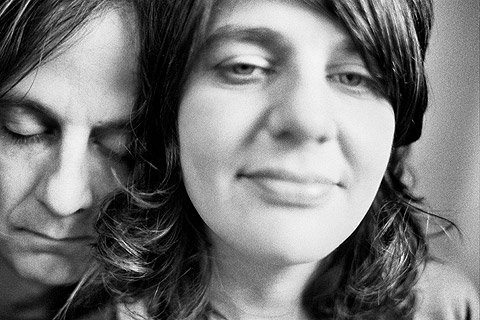
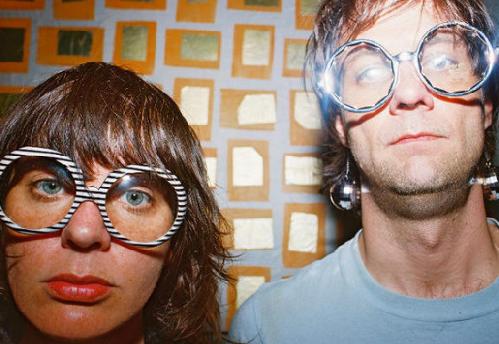
 Jennifer
Shagawat met John “Shell” Driver about 15 years
ago at a DIY performance space in San Francisco called Starcleaner.
They started making music together – at about the
same time that the White Stripes were making a name for
themselves in Detroit – and eventually wound up in
Brooklyn as Shellshag. For a combo that pares rock ‘n’
roll down to its essentials – one guitar, a minimal
drum kit, two voices – Shellshag has always kept things
interesting, from the belt of bells that Jen wears and jiggles
for additional percussion to the innovative new “pyramid
of sound” that the band brings with them on stage,
which combines lights, speakers, and effects. They’re
also one of the rare Brooklyn bands that’s as home
in the DIY lofts and warehouses of Bushwick as the basements
of New Brunswick; the pair have insinuated themselves into
New Jersey’s underground scene so thoroughly that
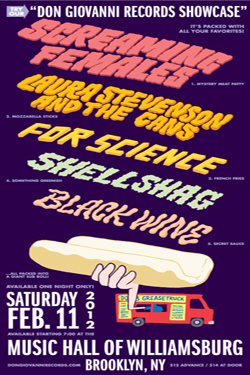
they’ll be appearing this weekend as part of Don Giovanni
Records’ annual showcase concert with Screaming Females
and For Science. Recently Shellshag released its first album
of covers, “Fuck Society Vol. 1,” on Mauled
By Tigers, which includes songs by bands as diverse as INXS,
Liz Phair, and Underground Railroad To Candyland. We talked
to Jen and Shell via speakerphone to catch up with the dynamic
duo’s current activities. You need to have them both
in the conversation because, like any couple that’s
been together a long time, they’ll often wind up finishing
each other’s sentences or thoughts, but it was a pleasure
talking to both of them. Jennifer
Shagawat met John “Shell” Driver about 15 years
ago at a DIY performance space in San Francisco called Starcleaner.
They started making music together – at about the
same time that the White Stripes were making a name for
themselves in Detroit – and eventually wound up in
Brooklyn as Shellshag. For a combo that pares rock ‘n’
roll down to its essentials – one guitar, a minimal
drum kit, two voices – Shellshag has always kept things
interesting, from the belt of bells that Jen wears and jiggles
for additional percussion to the innovative new “pyramid
of sound” that the band brings with them on stage,
which combines lights, speakers, and effects. They’re
also one of the rare Brooklyn bands that’s as home
in the DIY lofts and warehouses of Bushwick as the basements
of New Brunswick; the pair have insinuated themselves into
New Jersey’s underground scene so thoroughly that
they’ll be appearing this weekend as part of Don Giovanni
Records’ annual showcase concert with Screaming Females
and For Science. Recently Shellshag released its first album
of covers, “Fuck Society Vol. 1,” on Mauled
By Tigers, which includes songs by bands as diverse as INXS,
Liz Phair, and Underground Railroad To Candyland. We talked
to Jen and Shell via speakerphone to catch up with the dynamic
duo’s current activities. You need to have them both
in the conversation because, like any couple that’s
been together a long time, they’ll often wind up finishing
each other’s sentences or thoughts, but it was a pleasure
talking to both of them.
Q: What inspired you to record an album of covers?
Jen: A friend of ours, Jesse James, who runs the record
label Mauled By Tigers, it was her idea. Years ago I really
didn’t like doing covers, and then Shell got me into
doing them. She’s actually been after us to do this
for years, and now it’s finally here.
Shell: We had a collection of cover songs that gradually
built up over the years. I think the very first cover we
did as a band was the Liz Phair song, “Fuck And Run.”
That goes way back to when we first started playing as a
two-piece, with the non-acoustic setup, in the early 2000’s.
Once we got to the point where he had learned enough covers
to do an album, that’s the point where Jesse started
telling us that we should record them. We did so many that
we can’t do them all in one set, you can only do a
couple each show, so she said we should just put them all
on one record. And it started from there.
Jen: That’s also why the album is called “Volume
1.” Because there’s so many that we do now,
so we figured we’ll make this “Volume 1”
and we’ll just keep doing them. Because it’s
become so much fun now, we just keep learning more. We even
put together this medley – we’ll be doing it
at the Don Giovanni show – that’s just a bunch
of our favorite bands bunched into one song. We’re
going to San Francisco in March to record a new album, and
while we’re there we’re going to record a bunch
of other covers and just keep ‘em going.
 Q:
I like the fact that the album reaches all ends of the musical
spectrum, from really mainstream stuff like INXS to punk
rock classics like Descendants and Buzzcocks, to some fairly
obscure indie bands that a lot of people probably won’t
even recognize. A few of them could probably pass as originals
if you didn’t introduce them as covers. Q:
I like the fact that the album reaches all ends of the musical
spectrum, from really mainstream stuff like INXS to punk
rock classics like Descendants and Buzzcocks, to some fairly
obscure indie bands that a lot of people probably won’t
even recognize. A few of them could probably pass as originals
if you didn’t introduce them as covers.
Shell: The thing is, they don’t seem obscure to us.
They’re from our record collection, they’re
songs we listen to all the time and really love. That’s
why we’re playing them. We’ll hear a song that
we like and we’ll fool around with it at practice,
and sometimes we’ll say, hey, we do a really nice
little version of that, we should play that one. Once we
get going, if we get a song that we think sounds good, it’ll
stick around for a while. But from our collection, those
are all songs we listen to all the time, from that Warsaw
song to the Descendents. We could have done any song from
I Don’t Wanna Grow Up, we play that record constantly.
It’s one of those records where you just scream along
to it while it’s playing in your bedroom. There are
a few of them like that. And then with the newer bands,
we play with those guys live and when you watch them, you’re
thinking, man, we should be doing that song, that sounds
great. So all those songs mix together pretty naturally
to us, they’re all just greatest hits.
Q: Let’s talk a little about the two-piece
thing. I was thinking back to the first time I heard the
White Stripes in the late Nineties. They really seemed like
a novelty at the time. But today you look around and there
are dozens of these two-piece acts. Do you think that’s
a reflection of the economy, especially the music industry,
and the fact that it’s just so much easier and less
expensive to tour with just two people?
Jen: That’s a good question.
Shell: I really don’t know to what degree that’s
true, but I would guess there are a large percentage of
the bands in that situation were looking for a third person
and unable to find that third person, they realized the
advantages of keeping it at two. Two is really perfect.
Jen: You know what’s funny, years ago when we were
playing SXSW, they actually paid us less because we were
two people. And then years after that, they changed it.
Shell: I think they realized that not only was it unfair,
but it didn’t make sense. If you have ten people in
the band, do you pay them more? Of course not.
Jen: I can’t speak of anyone else, but for us, yes
it is an advantage. I think maybe the White Stripes just
opened a door to something that a lot of people were doing
anyway just out of necessity. And finally when a band was
successful as a two piece, it kind of opened the door for
radio and the record labels to say, okay, you’re allowed
to be a two piece and still be a band. I was kind of psyched
about that with the White Stripes. It did make it more acceptable
in way for what we were doing.
Shell: I think what’s probably more relevant, as far
as the White Stripes, is that it was a boy/girl duo. Back
in the 60’s and 70’s, you had duos like Sonny
& Cher, Captain and Tennille, the Carptenters, but they
always had backing orchestras. No one ever really considered
them a two-piece because there were always other people
on stage doing the music. Then you have bands like Japanther
and Black Keys, and a lot of other duos out there, and we
don’t really get compared to them much. But the boy/girl
thing is the real connector, I think that’s why people
connect the White Stripes to what me and Jen are doing.
Q: When I think of rock ‘n’ roll bands
with just one guitar, I always think of Buddy Holly, who
kind of invented a way of playing rhythm and lead at the
same time. As a guitarist, hass that early rock ‘n’
roll sound been a big influence?
Shell: I have listened to a lot of that stuff, but to be
honest, I do a lot of cheating when it comes to that kind
of thing. I play through my microphone so I get a little
extra organ-y whistle going for leads and stuff. I often
wish I was a sharper player because you can do a lot with
one instrument. But I think we utilize our voices and maybe
distortion a lot to fill up spaces, whereas some of those
older bands had an amazing guitarist.
Jen: And when we’re recording, we definitely create
more of a big band vibe.
Shell: Yeah, we definitely add more tracks and other players
to build a song.
Jen: Live is a completely different beast. And part of it
for me has been fun because we’ve talked a lot about
adding organs or adding things that we could do to fill
the sound out, especially if we’re playing a larger
place. But it never really feels right. It almost feels
like we’re cheating. Well, not cheating, that’s
not the right word, but not being true to ourselves.
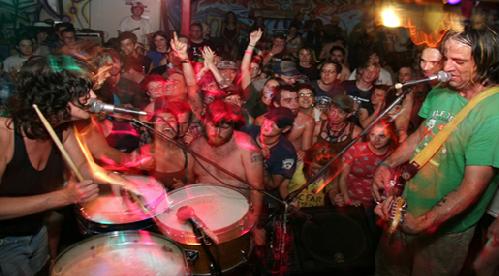
Shell: We’ve played a few shows where we’ve
had another guitar player come up and play with us, and
it sounds fantastic, but it completely changes the dynamic
on stage. Suddenly you have this person who’s actually
facing the audience, whereas usually people are just focused
on watching me and Jen stare each other down all set. There’s
a lot of challenged to creating that dynamic with just two
people.
Jen: And that struggle has become a real fun part of the
project for me. It’s really difficult to fill out
the sound when it’s just the two of us. There’s
something about us almost failing every single time every
second that adds to the joy of it all. That danger is really
the essence of what we do.
Shell: We’re not that guy who’s walking across
the highwire effortlessly. We’re hanging on by one
arm and threatening to fall every single second.
Jen: And we feel so rewarded every night by that. Every
show, we get off stage and we think, ‘man, we pulled
this off, just the two of us. How did we do that?’
But the records are getting to be a lot more fun for us
too. Because we get to hear ourselves the way we’d
like to hear us. But I think for the live show, it still
works best when people are huddled right around us and it’s
a small room. We really have a good time with the energy.
It’s different in a big room when you’r eup
on a big stage. That becomes a real challenge because we’re
this teeny little unit and you want to use it all.
Q: Well, you’re playing Music Hall of Williamsburg
for the Don Giovanni showcase, which is a pretty big room.
Do you prepare differently when you’re getting ready
for that kind of show? Do you build the set list different
than if you were playing a basement show to a dozen kids
somewhere?
Shell: A little bit. Not entirely. But because we know the
sound will be really good there, it’s an opportunity
to do some songs that we know we can pull off really well
when we can hear ourselves. At a party or a basement, it’s
fun for us to know we can do that but you usually can’t
even hear yourself so we might do a set of more driving
stuff and just feed off the energy. That might be the only
difference. Otherwise we have our own little system and
it seems to work well.
Jen: I don’t know if you’ve seen us recently
but Shell built this thing called the Pyramid Of Sound that
we use on stage now. It’s basically a five-sided pyramid
that stands between us.
Shell: It’s got twelve speakers and it takes in all
the guitar tones and all the vocals, and it all just comes
out…
Jen: …of this one giant unit. With the mics and everything.
So it’s really unique in that way. It becomes a really
intimate experience. So we’ve been thinking about
the bigger shows differently, because you have to control
that.
Shell: To go back to your question though, the honest answer
is that we put together a special set list every time we
do a show. Because we play the smaller places a lot more
than the bigger ones. How it’s different is that when
we’ve done the Don Giovanni shows, or when we were
in Europe with Japanther playing bigger places, we put together
a very specific set list for those shows. You just have
to because you have to tell the soundman what you’re
doing and you have a specific set time. When we play the
parties, we try to play all our songs all the time, so when
we’re at a party, we can just go through any one of
them that pops into our head and even do a 25 or 30 song
set list.
Jen: The Don Giovanni showcase is special because we’re
such good friends with those people and the other bands
are so awesome. So we want to do a really special set.
Shell: We were wrestling yesterday with the problem of whether
we do a few less songs and a couple of longer ones. Or if
we pull the longer ones, we can fit in four songs for those
two. So what do we do? We still haven’t decided.
Jen: We just know that we’re just going to get up
there and play… and try to cram as much in as we can
into a 30 minute set. But you know what I wanted to say?
Going back to the covers thing, it’s interesting at
this point in our lives to look back and look at all the
music that’s influenced you. So Volume 1 is really
only a start… you could picture Volume 24 and all
the songs we could be doing by then. And we’ve even
thought about giving other volumes over to other bands and
having them cover us. Because kids have been covering our
music, three different bands now have done our songs and
do incredible versions. So it’s opened this conversation,
and often it’ll be like, okay, they covered one of
our songs, we’re going to cover them.
Shell: When a band’s got a good song and they play
it for a long time, it’s like they do their standards,
and the song is so freakin’ good that eventually no
one even remembers it’s an original anymore, it’s
like the song’s always been there.
Jen: That’s how Shell actually refers to the covers
record, he calls it our standards.
Shell: They’re standards. Everybody wants to play
these songs.
Jen: Everyone can, and everyone should.
Q: How about going forward? What’s happening
next?
Shell: We’re recording a new album of originals in
March. We fuckin’ started on it and we got a little
wealth of songs, and we’ll probably have to trim a
few of those, and then pull a few gems out of the archives,
and we’ll have a new record. We even have two working
titles: “The Pyramid of Sound,” or “Keeping
The Mission Alive.”
Jen: And we had one other one. “Sorry The World Sucks,
But It’s Not Our Fault.”
You can find more about Shellshag at www.starcleaner.com
.
JerseyBeat.com
is an independently published music fanzine
covering punk, alternative, ska, techno and garage
music, focusing on New Jersey and the Tri-State
area. For the past 25 years, the Jersey Beat music
fanzine has been the authority on the latest upcoming
bands and a resource for all those interested in
rock and roll.
|
|
|





 |
|