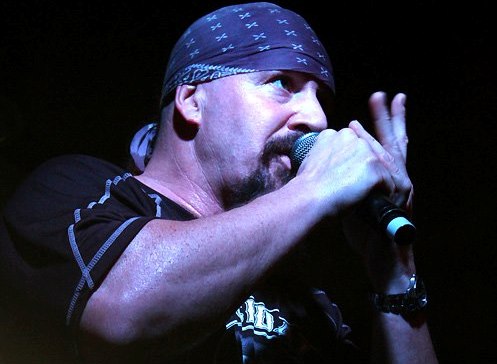


MIKE MUIR: The Jersey Beat Interview
By Deborah J. Draisin
Suicidal Tendencies has stood the ultimate test of
endurance: time. Embarking upon their thirtieth anniversary
with renewed vigor in the form of a brand new album, “13,”
which feels like a throwback to their heyday and on currently
tour with hardcore vets D.R.I. and Sick of it All, Suicidal
Tendencies has reached that point in their career where
you can look through their crowd and see people of multiple
generations circle pitting and screaming along. They are
beloved in no small part because of lead singer Mike Muir’s
slogany approach to life and down-to-earth attitude. Mike
has spoken with Jersey Beat before, so it was fun to see
where he’s at now with everything
Q: I was watching some old clips of The Headbangers’
Ball, and I found one of you telling Riki Rachtman - circa
late 80’s or early 90’s - that you didn’t
know how much longer you would be in Suicidal ; what would
you like to add to that statement now?
Mike: To be quite honest, that was the truth. When I was
growing up, I didn’t think that I would live to be
30. Doing the band I didn’t think would be able to
survive, because it wasn’t really a dream or a goal;
it’s always been a challenge. You’re on tour
for 10 months and then you get back, people in your life
will say “Wow, you seem so much happier.” You
don’t realize it, but it feels like you’re fighting
other people’s battles and they’re not appreciating
it.
We have the approach that every show might be our last
one, and it’s not about self-combustion, but 1) I’ve
had a few back surgeries and 2) there are so many bands
who get back together because they just don’t like
their lives or their families, and I come from the complete
opposite way.
Q: You hear that a lot from bands, that tour burnout
- usually around the 10 year mark - when you start to question
everything.
Mike: I don’t think it’s burnout; what it is
with us is priorities. I have a lot of friends who tell
me “If I had a dad like yours, I wouldn’t have
had all the problems that I did.” I don’t want
to be the one whose kids come up to me and say “Hey
Dad, you weren’t there for me when I needed you.”
It’s a heavy balancing act.
My dad said to me when I was younger something that’s
always stuck with me: “I’m not telling you this
because I’m bigger than you, but because it’s
the right thing and it’s what you need to hear.”
I totally understand that now. We say no to a lot of things
to which other people would say “Oh, that’s
a great opportunity; thousands of bands would love to do
that!” We say “Well, them do that.”
I want my kids to know that whatever I’m doing is
important, not just to get away from the family and party.
Q: Do you think that’s something that happens
a lot, that the kids wind up resenting the job?
Mike: Well, I think that people may not know better. There
are friends who trip me out because they’re talking
about their dad, that they hate him, he’s an asshole,
he’s an alcoholic and meanwhile, they’re drinking
while they’re talking about him. My dad always says
“Don’t ever become what you hate. Learn from
others’ mistakes, don’t repeat them.”
So, you do what you can to work around things. If it’s
a holiday or someone’s birthday, we’re not playing.
Q: Does it take a while to get to that point, or
did you put that into practice right away?
Mike: We were on tour with Europe with Guns N’ Roses
and then Metallica in 1993 and when I got back home, my
girlfriend at the time was like “Wow, about time.”
You know, back then, we didn’t have computers and
I didn’t have a lot of money, and if I would’ve
called, you would’ve thought that something was wrong.
My mom had actually gone into the hospital with a heart
attack, and they didn’t want to tell me because they
knew that I would freak. When I talked to my Mom, I went
“If something would’ve happened to you…”
but she said “I knew that I was going to be okay;
there was nothing that you could do. To have you fly home
and be all worried would have made me feel worse.”
I understand that, and it’s probably what I would’ve
done.
On the last 2 tours that we did, people had parents pass
away before they could get there, and it’s one of
those things where you just go “It’s not about
music, it’s about life.” I won’t ever
let it become a job, where you have to do things. If it’s
a Saturday night and someone has a wedding to go to, we’ll
say “Go” and we won’t play the gig. Some
people will complain “That’s not Rock N’
Roll!” and I say “Yeah, I know it’s not,
it’s Suicidal, so fuck you.”
Q: You guys have always had your own aesthetic from
the very beginning; you’ve never copped to any stereotypes
or done what people expected of you. You’ve never
gone with the grain or with the pack, and that’s something
which has set you guys apart, I think, and that’s
a great thing. You quote your dad a lot, by the way. Has
he always been an influence in your life, or is this just
kind of now that you’re a parent, too?
I moved out when I was 16 and spent a lot of time trying
to prove my dad wrong, and it was wasted. Right is right.
My dad taught me not to think in terms of odds, but of what
needs to be done – there is always a way to get something
done. There are no shortcuts; we always find out that the
easy way was the hardest way in the long run. My dad never
shows fear. I mean, everyone gets scared, but use fear to
make sure that you’re prepared, but not to hinder
you from accomplishing anything.
We oversimplify things, but there are a lot of people who
just don’t think, you know? They make things bigger
than they need to be, like taking a bazooka to kill an ant.
Scars - the physical ones – they go away, but the
mental ones last forever.
Q: Don’t you think that we make our little
problems bigger so that we can handle them, rather than
the big world problems which we don’t feel that we
can conquer?
We do! It’s like the Wizard of Oz, we magnify them
“Oh, but what can I do? Look at that, how can I do
anything?” We live in a world like that and then nothing
does get done. Everything does become bigger due to lack
of effort. Like with any great invention, it comes from
that point, with someone saying that there has to be a better
way of doing something even though it seemed impossible.
Q: Speaking of things which seemed impossible and
finally got done, let’s talk about the number 13 and
your long journey to the new release.
To sum it up in the quickest way, 13 has always been my
favorite number, and it comes from that - not to try to
get a reaction out of people. We’ve had reactions
from people: “Oh, that’s bad luck!” Like,
why is it bad luck?
Q: Nobody knows.
Yeah, exactly. In Japan, their elevators don’t have
a 4th floor, because there, the number 4 represents death.
So we go from 12 to 14 here, and somehow, the 13th floor
doesn’t exist, even though you know that the 14th
floor is the 13th floor.
Q: Maybe we should design a World Elevator with
all of the numbers which are bad luck missing and see how
many floors we end up with.
Exactly! Anything which people believe, they give power
to, whether it’s good or bad.
We just wanted to have a record which felt like going back
through a time machine, that if I was playing straight through
at 15, I would go “Whoa!” We didn’t want
to make a record which sounded old, but one that people
not even 20 years old hearing even 20 years from now at
would say “Wow, that’s a great record.”
A lot of people, the first thing that they ask is: “Well,
what style is it? Is it punk, is it metal?” and we’re
just like “Why do you want to categorize something
so quickly, not care only if it’s good?” That
takes time, but I do think that there are a lot of people
who are going to love it for the right reasons.
Q: I find that most bands - especially ones who
have been around the block – refer to themselves as
rock bands, they refuse to categorize themselves. Their
fans will be really rabid about the title, but they’ll
be like “I don’t know, we just play music.”
Yeah…I think it’s good for us. When our first
record came out, the punk fans said that it sucked, that
it wasn’t punk, and the metal fans said that it sucked,
that it wasn’t metal; we didn’t fit in anywhere
and we didn’t care. I think that bothered people.
It’s weird, we get put down for a lot of things, but
you look at other people who adapt, maybe change the way
that they dress or their music to fit into a trend, that
type of thing. I truly don’t think that we’re
influenced other than by what we all like, and not to repeat
what we don’t like. I think that’s the difference.
I don’t know many people who don’t want to
put out a record because they hate feeling like they have
to defend music that they don’t think people will
understand.
People might say to me “Oh, that lyric is stupid”
and I’ll respond “You tell me what it’s
saying, if it’s stupid.” They go “I don’t
know, it’s just stupid, Man.” You just don’t
understand it, but I’m not going to explain it to
you.
We live in a world of instant gratification – triple
icing on the cupcake; sugar coat everything. That’s
not the way that our music is, but we’re fortunate
that there are a lot of others who aren’t concerned
about fitting in.
CONTINUED
HERE....
JerseyBeat.com
is an independently published music fanzine
covering punk, alternative, ska, techno and garage
music, focusing on New Jersey and the Tri-State
area. For the past 25 years, the Jersey Beat music
fanzine has been the authority on the latest upcoming
bands and a resource for all those interested in
rock and roll.
|
|





 |
|